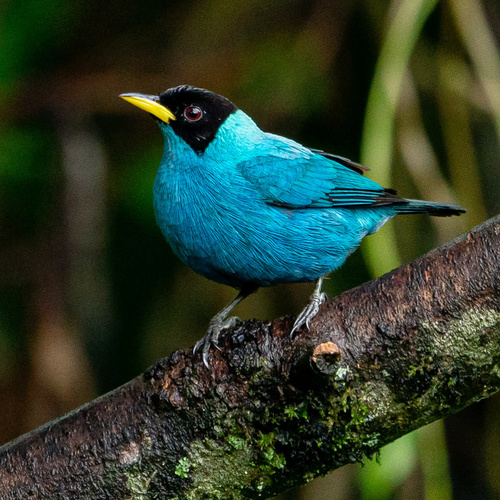
Green Honeycreeper
Chlorophanes spiza
With its neon-emerald plumage and striking black mask, the Green Honeycreeper is a jewel of the tropical canopy. A frequent visitor to fruit feeders, this acrobatic tanager brings a splash of electric color to backyards from Mexico to Brazil.
Quick Identification
Size
13–14 cm (5–5.5 in) long; 14–23 g (0.5–0.8 oz)
Colors
Males are iridescent emerald or blue-green with a distinct black crown and face; females are a uniform bright grass green with yellowish underparts.
Key Features
- Striking iridescent emerald-green plumage (male) or grass-green (female)
- Black 'hood' or mask covering the crown and face (male)
- Decurved bill with a bright yellow lower mandible
- Red iris visible in good lighting
When You’ll See Them
Geographic range
Where Does the Green Honeycreeper Live?
This stunning tanager is native to the humid Neotropics, spanning from southern Mexico across Central America into South America as far south as southern Brazil and Bolivia. It is also a resident of the island of Trinidad. Within this vast area, it thrives in lowland and foothill regions, particularly where forest canopies remain intact or where suburban gardens provide a lush bridge between wild habitats.
Basemap © OpenStreetMap contributors
Behavior
Green Honeycreepers are energetic and agile foragers, often seen hanging upside down to reach nectar-rich flowers or ripe fruit. While they spend much of their time in the forest canopy, they are surprisingly bold and will readily descend to garden feeders or fruiting trees near human dwellings. They are social birds, frequently joining mixed-species flocks with other tanagers and honeycreepers to search for food.
Unlike some more skittish forest birds, they can become quite accustomed to human activity, especially if a reliable food source like a nectar feeder or fruit tray is present. Their vocalizations are mostly thin, high-pitched 'tsips,' which are more functional for staying in contact with a flock than for elaborate song.
EverydayEarth exclusive
Camera Tips
To capture the brilliant iridescence of the Green Honeycreeper, placement is everything. Position your camera near a nectar feeder or a 'fruit table' stocked with halved oranges, bananas, or papaya. Since these birds are canopy dwellers by nature, mounting your camera 5 to 10 feet off the ground on a sturdy branch or post overlooking the feeder will yield more natural perspectives than a ground-level setup.
Lighting is the secret to making their emerald feathers 'pop.' Try to angle your camera so the sun is behind it, front-lighting the bird. In deep shade, their feathers can look dark and dull, but direct morning light reveals their true neon glow. High-speed shutter settings or 'burst mode' are essential, as these birds move with a frantic, jerky energy that can lead to motion blur in low-light conditions.
If you aren't using feeders, look for flowering trees like Erythrina (Coral tree) or fruiting shrubs. Set your camera to a wide-angle view if the area is dense with foliage, or use a macro focus if you can get the camera within 2–3 feet of a specific flower cluster they frequent. Early morning is the 'golden window' when they are most active and hungry, making them more likely to linger in front of the lens.
Similar Species
Species that look similar or are commonly confused with Green Honeycreeper.
Red-legged Honeycreeper
Males are deep blue rather than green and feature bright red legs; females have streaked underparts.
Blue Dacnis
Males are turquoise-blue with black around the eyes and on the back; females are green but have a blue head.
Shining Honeycreeper
Has bright yellow legs and a much longer, more curved bill than the Green Honeycreeper.
Frequently Asked Questions
Record Green Honeycreeper at your habitat
Connect a camera to start building your own species record — AI identifies every visitor automatically.