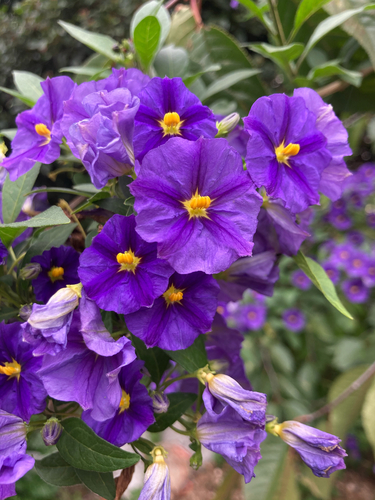
blue potatobush
Lycianthes rantonnetii
A royal splash of color for any garden, the blue potatobush is a South American treasure that blooms with thousands of violet-purple flowers and attracts a wealth of pollinating life.
Quick Identification
Size
Height of 1.8–3 meters (6–10 feet) with a similar spread of 1.5–2.5 meters (5–8 feet).
Colors
Brilliant violet-blue to deep purple flowers with a bright yellow-orange central 'eye'; leaves are vibrant mid-to-dark green.
Key Features
- Trumpet-shaped purple flowers with a distinct yellow center
- Arching, woody stems that can be trained as a shrub or small tree
- Elliptic, wavy-edged bright green leaves
- Small, dangling red heart-shaped berries that resemble cherry tomatoes
- Continuous blooming cycle from late spring to first frost
When You’ll See Them
Geographic range
Where Does the blue potatobush Live?
The blue potatobush is native to the diverse landscapes of South America, with its core range spanning across Argentina, Paraguay, Brazil, and Uruguay. Because of its hardy nature and stunning floral display, it has been widely introduced to other continents as a popular ornamental plant. You can now find it thriving in the wild and in gardens throughout the southern United States, Southern Europe, and parts of Australia, where the climate mimics its warm, subtropical origins.
Basemap © OpenStreetMap contributors
Behavior
The blue potatobush is a fast-growing, sun-loving shrub known for its prolific and near-constant flowering. While it is not sentient, it exhibits a clear 'sun-tracking' growth habit, with its arching branches reaching toward the light to maximize its photosynthetic energy. In frost-free climates, it behaves as an evergreen, maintaining its lush foliage year-round, while in cooler regions, it may go dormant or act as a deciduous plant.
This species is highly attractive to various pollinators, particularly bees and butterflies. It employs a specific reproductive strategy common in the Solanaceae family where the flowers require 'buzz pollination'—a process where bees must vibrate their bodies at a specific frequency to trigger the release of pollen from the yellow anthers. Despite its beauty and utility for insects, the plant contains solanine and is toxic to humans and most mammals if ingested.
EverydayEarth exclusive
Camera Tips
Capturing the blue potatobush on an AI-powered camera is a rewarding way to document the local pollinator ecosystem. To get the best results, mount your camera on a steady stake or tripod about 3 to 4 feet off the ground, aiming at a cluster of flowers that receives direct morning sunlight. Because the deep violet petals can absorb light, avoid positioning the camera directly against a harsh midday sun, which can wash out the colors; instead, aim for side-lighting to highlight the texture of the leaves and the bright yellow centers.
Since this plant is a favorite for bumblebees and carpenter bees, set your camera to 'Video' or 'Burst' mode with high trigger sensitivity during the morning hours (9 AM to 12 PM). This is when pollinators are most active. If your camera has a macro lens or high-resolution zoom, focus specifically on the yellow anthers to see the 'buzz pollination' in action, where the bee's vibrations create a visible cloud of pollen.
During late summer and autumn, look for the small red berries that replace the flowers. While toxic to humans, these fruits often attract specific bird species. Adjust your camera angle to capture the lower branches where these berries hang. For a unique perspective, try a time-lapse setting over a 24-hour period to watch how the flowers slightly close or droop during the night and refresh themselves as the sun rises. Keep the lens clear of stray branches, as the potatobush grows rapidly and can quickly obscure the camera's view.
Similar Species
Species that look similar or are commonly confused with blue potatobush.
Frequently Asked Questions
Record blue potatobush at your habitat
Connect a camera to start building your own species record — AI identifies every visitor automatically.