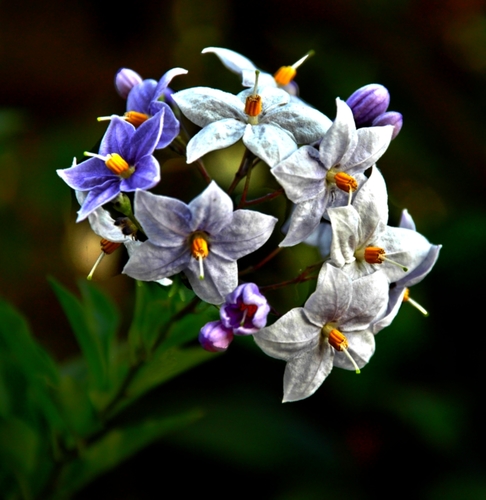
potato vine
Solanum laxum
A cascading climber known for its starry white blooms and incredible vigor, the potato vine is a backyard favorite that brings a touch of South American elegance to any garden fence.
Quick Identification
Size
A vigorous climber reaching lengths of 6-9 meters (20-30 feet) with leaves 5-10 cm (2-4 inches) long.
Colors
Pure white to pale bluish-white flowers with prominent yellow central anthers; deep green, glossy foliage.
Key Features
- Five-petaled star-shaped flowers in clusters
- Vigorous climbing habit using twining stems
- Bright yellow cone-shaped anthers at the flower center
- Semi-evergreen to evergreen lance-shaped leaves
When You’ll See Them
Geographic range
Where Does the potato vine Live?
The potato vine is originally native to the temperate and subtropical regions of South America, specifically centering around Brazil, Argentina, Uruguay, and Paraguay. Due to its popularity as an ornamental, it has been widely introduced and has naturalized in Mediterranean-style climates globally. You can now find it flourishing across coastal California, parts of the southern United Kingdom, Australia, New Zealand, and various regions of the Mediterranean basin, where it thrives in sun-drenched positions with mild winters.
Basemap © OpenStreetMap contributors
Behavior
The potato vine is a fast-growing, woody perennial climber known for its prolific blooming period. Unlike many vines that use tendrils or adhesive pads, Solanum laxum climbs by twining its leaf stalks around supports like trellises, fences, or other plants. It is highly valued in garden settings for its ability to provide dense screening and a long-lasting display of flowers that can persist from late spring through the first frosts of autumn.
While it is a member of the nightshade family, it does not produce edible fruit; in fact, its small dark berries and foliage contain solanine and are toxic if ingested. In the garden, it acts as a magnetic hub for biodiversity, particularly attracting hoverflies, bees, and butterflies that are drawn to the nectar-rich white blossoms. It is generally well-behaved in temperate zones but can become somewhat aggressive in warmer, frost-free climates where it grows year-round.
EverydayEarth exclusive
Camera Tips
To capture the stunning growth of a potato vine, position your camera at a mid-range distance (3-5 feet) from a trellis or fence where the vine is actively blooming. Because this species is a plant, the most rewarding results come from using a time-lapse setting. Set your camera to take a photo every 30 minutes during daylight hours to document the way the flowers track the sun and how the twining stems slowly spiral around their support structures.
For those interested in the wildlife that visits the vine, aim your camera at a dense cluster of open blossoms during the warmest part of the day. Use a high-speed trigger setting to capture the rapid movements of pollinators like carpenter bees and hoverflies. Because the white flowers can easily 'blow out' or become overexposed in bright sunlight, try to angle the camera so it is slightly shaded or wait for overcast days to capture the delicate blue tints in the petals and the vivid yellow of the anthers.
Seasonal documentation is also key. In autumn, adjust your camera height to focus on the development of the small, dark purple-black berries. If your camera has a macro or close-focus mode, use it to highlight the contrast between the yellow central cone of the flower and the white petals, which provides a striking visual for AI identification. Avoid placing the camera too low to the ground; a chest-high mounting point usually offers the best perspective for both the foliage and the visiting insects.
Similar Species
Species that look similar or are commonly confused with potato vine.
Star Jasmine
Star jasmine has a powerful sweet scent and milky sap in the stems, whereas potato vine is mostly unscented and has yellow central anthers.
Bittersweet Nightshade
Bittersweet nightshade (Solanum dulcamara) typically has purple petals that curve backward, while potato vine has flatter, white-to-pale-blue petals.
Frequently Asked Questions
Record potato vine at your habitat
Connect a camera to start building your own species record — AI identifies every visitor automatically.