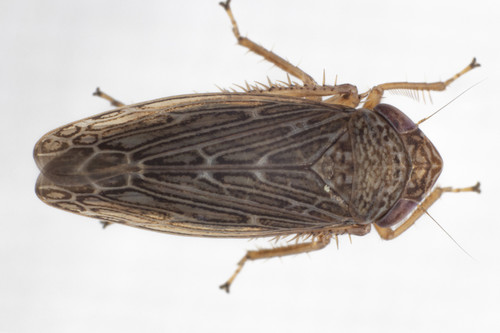
Blunt-nosed Leafhopper
Limotettix vaccinii
A tiny marvel of the cranberry bogs, the Blunt-nosed Leafhopper is a master of camouflage with a powerful spring in its step. Known for its unique rounded profile, this small insect plays a significant role in the delicate ecosystems of North America's wetlands.
Quick Identification
Size
4–5 mm (0.16–0.20 inches) in length
Colors
Mottled brown, tan, and grey with darker brownish-black spots and subtle pale veining on the wings.
Key Features
- Distinctly rounded, blunt head (vertex) when viewed from above
- Mottled 'peppered' brown appearance on the forewings
- Small, wedge-shaped body that tapers toward the rear
When You’ll See Them
Geographic range
Where Does the Blunt-nosed Leafhopper Live?
Native to North America, the Blunt-nosed Leafhopper is primarily found across the Northeastern United States and Southern Canada. Its range is heavily concentrated in regions with acidic, sandy soils that support Ericaceous plants, particularly in states like Massachusetts, New Jersey, Wisconsin, and the Canadian Maritimes. While its presence is tied to specific bog environments, it can occasionally be found in suburban gardens that feature native blueberry or cranberry cultivars.
Basemap © OpenStreetMap contributors
Behavior
The Blunt-nosed Leafhopper is a specialized feeder that spends its entire life cycle in close proximity to its host plants, primarily cranberry and blueberry bushes. These insects are hemi-metabolous, meaning they undergo incomplete metamorphosis. They hatch from eggs in the late spring as nymphs, appearing as miniature, wingless versions of the adults, and reach maturity by mid-summer. They are primarily known for their unique method of movement; while they can fly over short distances, they are famous for their powerful hind legs that allow them to 'hop' several feet in an instant when startled.
As sap-suckers, they use their needle-like mouthparts to pierce the stems and leaves of plants. In the wild and in agricultural settings, they are highly sensitive to the health of their host plants. Interestingly, this species is most famous among entomologists and farmers as the primary vector for Cranberry False Blossom disease, a phytoplasma that can significantly impact fruit production. Despite this, they are a vital part of the food web in wetland ecosystems, providing a protein source for spiders and small birds.
EverydayEarth exclusive
Camera Tips
Capturing a Blunt-nosed Leafhopper on camera requires a dedicated macro setup or an AI-powered camera with a very short focal distance. Because these insects are only a few millimeters long, placing your camera as close to the host plant as possible is essential. Target the tender new growth of cranberry vines or the underside of blueberry leaves, where they frequently congregate to feed and hide from the sun.
To trigger a recording, use a camera with high-sensitivity motion detection or high-speed video capabilities. These insects move incredibly fast when they jump, often appearing as a blur on standard frame rates. If your camera allows, set it to 60fps or higher to catch the moment of 'takeoff.' Because they are most active during the warmest part of the day, ensure your camera is positioned to avoid direct lens flare while still having enough ambient light to illuminate their subtle mottled patterns.
If you are struggling to find them, you can use a white 'beating sheet' or a simple piece of white cardstock held under a branch while you gently tap the plant. This will cause the leafhoppers to drop onto the white surface, making them easy to photograph before they hop away. For backyard setups, planting native Highbush Blueberry is the single best way to lure this species into view for your trail cam.
Similar Species
Species that look similar or are commonly confused with Blunt-nosed Leafhopper.
Frequently Asked Questions
Record Blunt-nosed Leafhopper at your habitat
Connect a camera to start building your own species record — AI identifies every visitor automatically.