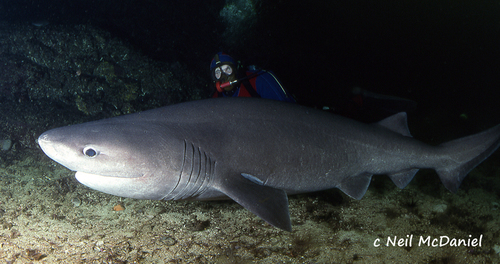
Bluntnose Sixgill Shark
Hexanchus griseus
A prehistoric giant of the deep, the bluntnose sixgill shark is a mysterious predator that has remained largely unchanged for millions of years. With its glowing green eyes and unique six-gill anatomy, it is one of the most enigmatic residents of our global oceans.
Quick Identification
Size
Typically 3.5–4.8 m (11–16 ft) in length, reaching up to 5.5 m (18 ft); weights can exceed 590 kg (1,300 lbs).
Colors
Tan, brown, or charcoal gray upper body with a pale white underside; distinctive light-colored lateral line along the flanks.
Key Features
- Six long gill slits on each side of the head
- Single dorsal fin located far back near the tail
- Large, emerald-green glowing eyes
- Broad, blunt snout with a wide mouth.
When You’ll See Them
Geographic range
Where Does the Bluntnose Sixgill Shark Live?
The bluntnose sixgill shark maintains a massive global presence, inhabiting nearly all temperate and tropical oceans across the planet. Its native range spans the Atlantic, Pacific, and Indian Oceans, with high concentrations documented along the Pacific coast of North America, the Mediterranean Sea, and the deep waters surrounding the British Isles. Because they prefer cold water, they are found at extreme depths near the equator but may be spotted in relatively shallow coastal fjords in regions like British Columbia and Washington State.
Basemap © OpenStreetMap contributors
Behavior
The bluntnose sixgill shark is a deep-water specialist known for its "living fossil" lineage, retaining skeletal features from the Triassic period. Unlike most modern sharks that have five gill slits, this species possesses six, an anatomical relic of its ancient ancestors. It is primarily a solitary hunter that spends its days in cold, dark depths of up to 2,500 meters, avoiding the light and heat of the surface.
As night falls, this shark engages in a behavior known as diel vertical migration, swimming upward into shallower waters to hunt. While they appear sluggish and slow-moving to conserve energy, they are capable of explosive bursts of speed when capturing prey. Despite their massive size, they are generally elusive and non-aggressive toward humans, though their sheer power and deep-sea habitat make them a rare and awe-inspiring sight for divers and researchers.
EverydayEarth exclusive
Camera Tips
Capturing a bluntnose sixgill shark on camera requires a specialized approach known as a Baited Remote Underwater Video (BRUV) system. Because these sharks live at depths far beyond the reach of standard backyard gear, you will need a high-pressure waterproof housing rated for at least 200-500 meters if you are deploying from a boat near a coastal canyon or fjord. Deep-sea environments are pitch black, so high-output external LED lights are mandatory. Many researchers use red-light filters, as sharks are less likely to be spooked by red spectrum light than by harsh white light.
Placement is everything when looking for this species. Look for steep underwater drop-offs, submarine canyons, or areas where the continental shelf breaks into the deep. In specific regions like the Pacific Northwest, these sharks are known to enter shallower waters near rocky reefs during the summer months at night. Use a heavy-duty anchor system to ensure your camera doesn't drift in deep-sea currents, and attach a mesh bait bag filled with oily fish like mackerel or squid to the camera frame to lure the shark into the frame.
For camera settings, prioritize a high ISO and a wide aperture (low f-stop) to pull in as much light as possible from your external sources. Since movement is often slow and majestic, 30 frames per second at 4K resolution is ideal for capturing the detail of their unique gill slits and green eyes. Always use a wide-angle lens, as these sharks are massive; a narrow field of view might only capture a blurry wall of gray skin rather than the whole animal. If you are lucky enough to live on a waterfront with a steep drop-off, a pier-mounted drop-cam can work, but ensure all cables are marine-grade to prevent saltwater corrosion.
Similar Species
Species that look similar or are commonly confused with Bluntnose Sixgill Shark.
Frequently Asked Questions
Record Bluntnose Sixgill Shark at your habitat
Connect a camera to start building your own species record — AI identifies every visitor automatically.