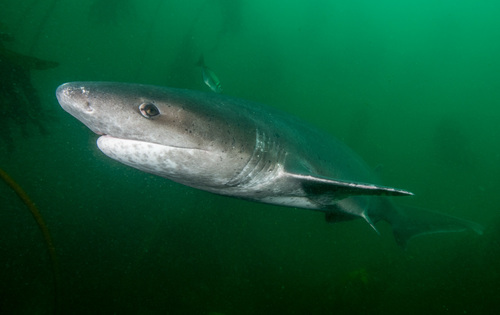
Broadnose Sevengill Shark
Notorynchus cepedianus
A prehistoric relic with seven gills and a spotted coat, the Broadnose Sevengill is the apex predator of the kelp forest. This social hunter bridges the gap between ancient shark evolution and modern coastal ecology.
Quick Identification
Size
Typically 1.5 to 2.5 m (5 to 8 ft), reaching a maximum of 3 m (10 ft); weighs up to 107 kg (236 lbs).
Colors
Counter-shaded with a silver-gray to olive-brown dorsal surface and a white underbelly; body peppered with small black and white spots.
Key Features
- Seven pairs of gill slits (instead of the typical five)
- Single dorsal fin positioned far back near the tail
- Broad, blunt snout and wide head
- Comb-like teeth in the lower jaw and jagged teeth in the upper jaw
When You’ll See Them
Geographic range
Where Does the Broadnose Sevengill Shark Live?
The Broadnose Sevengill Shark is a wide-ranging resident of temperate coastal waters across most of the globe, notably absent only from the North Atlantic and Mediterranean. Its core range includes the Pacific coast of North America from Canada to Mexico, the waters surrounding Australia and New Zealand, and the southern coasts of Africa and South America. These sharks are frequently found in shallow bays and estuaries, particularly in the San Francisco Bay and the kelp forests of South Africa, where they gather in high densities.
Basemap © OpenStreetMap contributors
Behavior
The Broadnose Sevengill Shark is a highly social and intelligent predator, often observed hunting in coordinated groups to take down larger prey like seals or other sharks. Unlike many shark species that are solitary, the Sevengill utilizes a pack-hunting strategy that allows it to dominate coastal ecosystems. They are known to be opportunistic and will scavenge when necessary, but they are primarily active hunters that use the cover of murky coastal waters to ambush their targets.
While generally non-aggressive toward humans in their natural habitat, they are considered potentially dangerous due to their size and proximity to shore. In bays and estuaries where they pup, they may become more territorial. Divers often report them as being inquisitive but cautious, frequently circling at the edge of visibility before disappearing back into the kelp forests.
EverydayEarth exclusive
Camera Tips
Capturing the Broadnose Sevengill on camera requires a specialized underwater setup, typically a Baited Remote Underwater Video (BRUV) system or a waterproof trail camera mounted within a protective housing. Because these sharks frequent murky, shallow bays and kelp forests, visibility is your biggest challenge. Mount your camera 12–24 inches off the seafloor, angled slightly upward to capture the shark's silhouette against any ambient light from the surface. This angle highlights the unique positioning of the single dorsal fin and the characteristic seven gill slits.
To attract a Sevengill to your lens, use a scent-based lure rather than large chunks of bait that might be carried away by scavengers. A perforated PVC pipe filled with oily fish like sardines or mackerel (a 'chum pod') works best. Place the lure about 3–5 feet in front of the camera lens to ensure the shark stays within the focal range. Avoid using bright artificial lights if possible, as they can startle the sharks; instead, rely on high-ISO settings or red-filtered lights for night captures.
The best time to deploy cameras is during the rising tide when these predators move into shallower flats and kelp edges to hunt. If you are filming in a high-current area, ensure your camera rig is heavily weighted with at least 5-10kg of lead or steel to prevent it from tumbling. Check your local regulations regarding 'chumming' or baiting, as some marine protected areas have strict rules about attracting predators. In temperate zones, late spring and early summer offer the best chances as adults move into bays to pup and mate.
Similar Species
Species that look similar or are commonly confused with Broadnose Sevengill Shark.
Frequently Asked Questions
Record Broadnose Sevengill Shark at your habitat
Connect a camera to start building your own species record — AI identifies every visitor automatically.