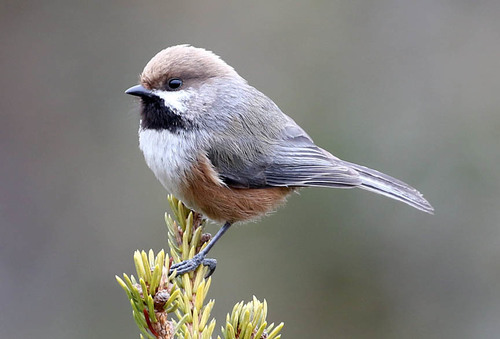
Boreal Chickadee
Poecile hudsonicus
The rugged inhabitant of the Great North, the Boreal Chickadee is a tough-as-nails songbird that thrives in frozen forests where few others dare to stay. With its warm brown cap and rusty flanks, it is a master of winter survival.
Quick Identification
Size
Length 12–14 cm (4.7–5.5 in); wingspan 18–21 cm (7.1–8.3 in); weight 7–11 g (0.25–0.39 oz)
Colors
Dull brown cap and nape, grey-brown back, white cheeks, and distinct rusty-cinnamon flanks. Males and females look identical.
Key Features
- Distinctive dull brown cap rather than black
- Rich rusty-cinnamon color on the flanks and sides
- Raspier, slower 'tsicka-dee' call compared to other chickadees
- Small, compact body with a short, dark bill
When You’ll See Them
Geographic range
Where Does the Boreal Chickadee Live?
This northern specialist is native to North America, spanning the vast boreal forests that stretch from Alaska across the Canadian provinces to Newfoundland. In the United States, its range dips into the high-elevation forests of the Pacific Northwest, the northern Rockies, the upper Great Lakes, and the rugged mountains of New England. These birds are year-round residents, rarely wandering far from their cold-climate homes except during occasional winter food shortages.
Basemap © OpenStreetMap contributors
Behavior
Boreal Chickadees are the hardy survivalists of the northern woods. Unlike their more gregarious cousins, they spend most of their time deep within dense coniferous forests, particularly among spruce and balsam fir. They are exceptionally active foragers, often seen acrobatically clinging to the tips of evergreen branches to inspect needles for hidden insects or spiders.
These birds are famous for their remarkable memories. To survive the harsh northern winters, they spend much of the late summer and autumn caching thousands of seeds and dead insects behind loose bark or within lichen. While they are generally less likely to visit suburban bird feeders than Black-capped Chickadees, they will occasionally venture out if their natural food sources are scarce or if they live near a forest edge.
EverydayEarth exclusive
Camera Tips
Capturing the Boreal Chickadee on camera requires a bit more finesse than more common backyard birds. Because they prefer dense cover, place your AI-powered camera near the edge of coniferous trees like spruce or fir. Setting the camera at a height of 4 to 6 feet is ideal, especially if you can angle it toward a moss-covered branch or a natural perching spot where the bird might pause before approaching a food source.
To lure them into frame, suet is your best friend. High-fat suet cakes, particularly those containing peanut butter or mealworms, are irresistible during the cold months when these birds are looking for high-calorie fuel. If you don't use a feeder, try spreading a small amount of 'bark butter' directly onto the trunk of an evergreen tree within the camera's focal range. This encourages the birds to stick around and forage naturally rather than grabbing a seed and flying away instantly.
Lighting is crucial in the dim boreal forest. Position your camera to face north or south to avoid the harsh glare of low winter sun, which can wash out the subtle brown tones of the bird's cap. Since these birds are very fast and move in short bursts, use a camera setting with a high trigger speed and a short cool-down period. If your camera supports burst mode or high-definition video, these are excellent for catching their distinctive 'upside-down' foraging behavior as they inspect the undersides of branches.
Similar Species
Species that look similar or are commonly confused with Boreal Chickadee.
Black-capped Chickadee
Features a crisp black cap instead of brown and lacks the rich rusty-cinnamon flanks of the Boreal Chickadee.
Chestnut-backed Chickadee
Has a much darker reddish-brown back and is primarily restricted to the Pacific Northwest coastal forests.
Mountain Chickadee
Possesses a prominent white 'eyebrow' stripe over the eye and a black cap, unlike the solid brown cap of the Boreal.
Frequently Asked Questions
Record Boreal Chickadee at your habitat
Connect a camera to start building your own species record — AI identifies every visitor automatically.