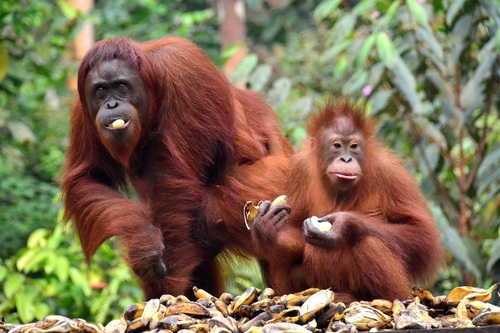
Bornean Orangutan
Pongo pygmaeus
Known as the 'Man of the Forest,' the Bornean Orangutan is a solitary genius of the canopy. With their iconic orange hair and incredible intelligence, they are the crown jewels of Borneo's biodiversity.
Quick Identification
Size
Height up to 1.5 m (4.9 ft); Males weigh 50–100 kg (110–220 lbs), Females 30–50 kg (66–110 lbs)
Colors
Shaggy reddish-orange to maroon fur; mature males feature blackish skin on their faces and large fleshy cheek pads
Key Features
- Arm span reaching up to 2.2 metres
- Shaggy, coarse reddish-brown hair
- Large, disc-like cheek pads (flanges) in dominant adult males
- Highly flexible joints allowing feet to act like hands
When You’ll See Them
Geographic range
Where Does the Bornean Orangutan Live?
Native to the tropical island of Borneo in Southeast Asia, these great apes are found across both the Indonesian provinces of Kalimantan and the Malaysian states of Sabah and Sarawak. Their range is restricted to this single island, where they inhabit fragmented pockets of primary and secondary rainforest. They are most commonly found in lowland areas near river basins and peat swamps where food is most abundant.
Basemap © OpenStreetMap contributors
Behavior
Bornean Orangutans are the world's largest arboreal mammals, spending nearly 90% of their lives high in the forest canopy. Unlike the more social African great apes, orangutans are primarily solitary. Adult males usually travel alone, while females are seen with their dependent offspring. They are highly intelligent tool-users, known to use sticks to test water depth or extract seeds, and they build elaborate new sleeping nests from branches and leaves every single night.
These apes exhibit a unique social hierarchy among males. 'Flanged' males are the dominant individuals, possessing large cheek pads and a throat sac used to produce 'long calls' that echo through the jungle to attract mates and warn off rivals. 'Unflanged' males are smaller and look more like females; they use their smaller size to move stealthily through the forest, avoiding direct confrontation with the larger dominant males.
EverydayEarth exclusive
Camera Tips
To capture the Bornean Orangutan on camera, you must think vertically. Since they rarely descend to the forest floor, ground-level trail cameras are unlikely to yield results unless placed near a known 'gap' in the canopy that forces them to the ground. For the best results, use climbing gear or a pulley system to mount cameras 10 to 20 meters high, targeting 'canopy bridges'—horizontal branches that connect large fruiting trees.
The most effective 'lure' for an orangutan is a naturally fruiting tree. Identify wild fig trees (Ficus spp.) or Durian trees within your survey area. During masting seasons, when these trees are heavy with fruit, orangutans will visit frequently and stay for extended periods. Focus your camera lens on the mid-canopy where they are most likely to forage or rest between meals.
Technical settings are crucial in the dim light of the rainforest sub-canopy. Set your camera to a high ISO and a fast trigger speed to avoid motion blur from their long, swinging limbs. Because they move with a slow, deliberate grace, a video setting of 20-30 seconds is often better than still photos to capture their complex social behaviors or tool-using intelligence.
Finally, be prepared for 'investigative' behavior. Orangutans are incredibly curious and strong. If they spot a camera, they may attempt to dismantle it. Use a heavy-duty security box and ensure the camera is scent-neutralized. High humidity is your biggest enemy in Borneo, so use extra desiccant packs inside the housing to prevent the lens from fogging during the rapid temperature changes at dawn and dusk.
Similar Species
Species that look similar or are commonly confused with Bornean Orangutan.
Frequently Asked Questions
Record Bornean Orangutan at your habitat
Connect a camera to start building your own species record — AI identifies every visitor automatically.