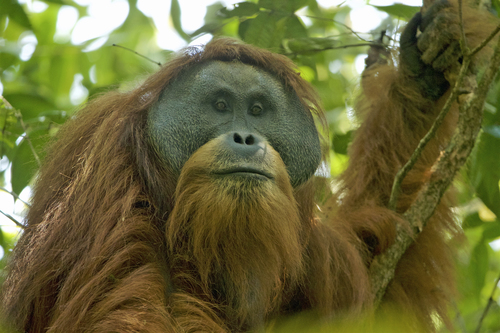
Tapanuli Orangutan
Pongo tapanuliensis
The world's rarest great ape, the Tapanuli orangutan, lives in a single hidden forest in Sumatra. Distinguished by its frizzy cinnamon fur and unique calls, this recently discovered species is a master of the high canopy.
Quick Identification
Size
Males 1.1–1.4m (3.6–4.6 ft), 70–90kg (154–198 lbs); Females 0.9–1.1m (3.0–3.6 ft), 30–50kg (66–110 lbs)
Colors
Frizzy, cinnamon or ginger-colored hair; males have flat cheek pads covered in fine downy hair; skin is dark grey
Key Features
- Extremely frizzy, cinnamon-colored fur
- Flatter and shallower face compared to other orangutans
- Males have prominent, hair-covered cheek pads (flanges)
- Unique 'long call' with distinct pulses and higher pitch
When You’ll See Them
Geographic range
Where Does the Tapanuli Orangutan Live?
Native to the continent of Asia, the Tapanuli orangutan is the most geographically restricted of all great apes. This species is found exclusively in the Batang Toru ecosystem within the South Tapanuli district of North Sumatra, Indonesia. Their entire world exists within a single, high-altitude forest block covering roughly 1,100 square kilometers, with no other populations found anywhere else on Earth.
Basemap © OpenStreetMap contributors
Behavior
Tapanuli orangutans are primarily arboreal, spending nearly their entire lives in the high canopy of the Batang Toru forest. They are the most solitary of the great apes, though they maintain loose social networks through vocalizations and occasional proximity. Males are known for their 'long call,' a haunting series of pulses that can carry for over a kilometer to mark territory or attract mates. Unlike their Bornean cousins, they rarely descend to the forest floor, likely an evolutionary adaptation to avoid ground-dwelling predators.
Their daily routine revolves around a search for high-energy food sources, moving slowly and methodically through the trees. They are highly intelligent, using simple tools and building complex sleeping nests from bent branches and leaves every single night. While generally shy and elusive, they are extremely sensitive to human encroachment and habitat fragmentation, which can disrupt their vital migratory paths within their small range.
EverydayEarth exclusive
Camera Tips
Capturing the Tapanuli orangutan on camera requires a specialized approach because they almost never touch the ground. To find success, you must mount your trail cameras high in the canopy, often 15 to 30 meters up, focusing on 'arboreal highways'—the thick, horizontal branches that serve as natural bridges between fruiting trees. Using climbing gear or long poles is essential for proper placement. Angle the camera slightly downward to capture the orangutan as it moves along the branch or reaches for fruit.
Because these primates are highly intelligent and naturally curious, they may investigate or even dismantle cameras that use visible red-glow infrared flashes. Use 'No-Glow' (940nm) black LED cameras to ensure the equipment remains invisible and doesn't stress the animals. High trigger speeds are vital; while orangutans move slowly compared to cats, their limbs are long and they can swing out of the frame quickly. A trigger speed of 0.3 seconds or faster is recommended to catch the full body rather than just a cinnamon-colored blur.
Placement should prioritize known 'mast' fruiting trees or areas near established nesting sites. Look for fresh nests—clumps of folded leaves high in the canopy—and set cameras on nearby access branches. Do not use food baits, as this can habituate the animals to human presence and increase their risk of poaching or disease. Instead, rely on natural attractants like ripening figs or durian trees. Ensure your batteries are high-capacity lithium, as the high humidity and remote locations of Sumatra make frequent maintenance trips difficult.
Similar Species
Species that look similar or are commonly confused with Tapanuli Orangutan.
Frequently Asked Questions
Record Tapanuli Orangutan at your habitat
Connect a camera to start building your own species record — AI identifies every visitor automatically.