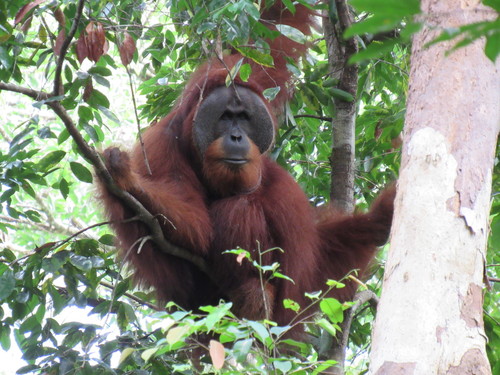
Sumatran Orangutan
Pongo abelii
Discover the Sumatran Orangutan, the iconic 'person of the forest' whose intelligence and flame-colored coat make them a crown jewel of the Indonesian canopy.
Quick Identification
Size
Height 1.2–1.7 m (4–5.6 ft) for males, 0.7–1 m (2.3–3.3 ft) for females; Weight 50–90 kg (110–200 lbs) for males, 30–50 kg (66–110 lbs) for females.
Colors
Distinctive long, shaggy hair in shades of pale orange to deep brick-red; mature males develop wide, flat cheek pads (flanges) and a large throat sac.
Key Features
- Shaggy reddish-orange hair covering most of the body
- Long arms that can span over 2 meters
- Narrower, longer face compared to other orangutan species
- Males feature a prominent, pendulous throat pouch for long calls
When You’ll See Them
Geographic range
Where Does the Sumatran Orangutan Live?
Native to the Asian continent, the Sumatran Orangutan is found exclusively on the northern tip of the Indonesian island of Sumatra. Their core range is now largely confined to the provinces of Aceh and North Sumatra, particularly within the protected confines of the Leuser Ecosystem. Because they are restricted to this single island, their habitat is incredibly specialized and vulnerable to fragmentation.
Basemap © OpenStreetMap contributors
Behavior
The Sumatran Orangutan is the most arboreal of all orangutan species, spending almost their entire lives in the forest canopy to avoid ground-level predators like the Sumatran tiger. They are remarkably intelligent, known for their sophisticated use of tools—such as using sticks to extract seeds from fruit or honey from beehives. Unlike their more solitary Bornean cousins, Sumatran orangutans exhibit a degree of sociality, often gathering in groups when large fruit trees are in season.
Daily life involves a rhythmic cycle of foraging, traveling, and resting. They construct elaborate sleeping nests from folded branches and leaves high in the trees each evening. While generally shy and wary of humans in the wild, they are highly observant, often watching intruders from a distance. Their social structure is dominated by flanged males who use booming 'long calls' to establish territory and attract females across vast distances.
EverydayEarth exclusive
Camera Tips
Capturing a Sumatran Orangutan on camera requires a focus on vertical space rather than the ground. Because these primates rarely descend to the forest floor, trail cameras should be mounted high—ideally between 10 to 20 feet up a sturdy trunk—overlooking known foraging trees like figs or durian. Use a wide-angle lens setting to capture their full arm span and the surrounding canopy environment. Secure your equipment with heavy-duty straps and lockable security boxes, as orangutans are notoriously curious and possess the manual dexterity to dismantle or 'reposition' cameras they find interesting.
Timing is everything when monitoring these 'people of the forest.' Set your camera to be most active during the early morning hours when orangutans leave their night nests to forage. Fast trigger speeds are less critical than in other species, as their movements are often slow and deliberate, but a high-quality video mode is recommended to document their complex tool-using behaviors and social interactions. Avoid using loud mechanical shutters or bright white flashes, which can startle them; instead, opt for 'No-Glow' or black infrared LEDs for night shots, though they are primarily active during the day.
If you are setting up in a forest-adjacent area, consider the seasonal fruiting cycles of local trees. During the peak of the fruit season, orangutans are more likely to visit these corridors. To get the best clarity, ensure the lens is clear of fast-growing vines or leaves that might obstruct the view in the humid tropical environment. Using a desiccant pack inside the camera housing is a must to prevent lens fogging in the high Sumatran humidity.
Similar Species
Species that look similar or are commonly confused with Sumatran Orangutan.
Frequently Asked Questions
Record Sumatran Orangutan at your habitat
Connect a camera to start building your own species record — AI identifies every visitor automatically.