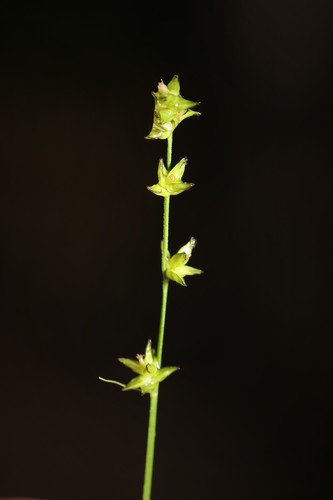
bracted sedge
Carex radiata
A woodland native known for its fountain of fine, hair-like leaves and whimsical star-burst seed clusters. The bracted sedge is the ultimate 'low-light' hero for native plant enthusiasts.
Quick Identification
Size
Grows in clumps 30–60 cm (12–24 inches) tall with narrow, grass-like leaves.
Colors
Bright yellowish-green foliage with small green-to-tan star-shaped seed clusters.
Key Features
- Distinctive star-shaped seed clusters (perigynia)
- Narrow, hair-like leaves under 2mm wide
- Compact, non-spreading clumping habit
- Lower flower clusters widely spaced on the stem
When You’ll See Them
Geographic range
Where Does the bracted sedge Live?
The bracted sedge is a quintessential native of central and eastern North America. Its geographic heartland stretches from the temperate forests of southeastern Canada down through the eastern United States, reaching as far west as the Great Plains and as far south as the Gulf Coast states. It is particularly abundant in the Appalachian highlands and the Great Lakes region, where it thrives in the dappled light of mature hardwood canopies.
Basemap © OpenStreetMap contributors
Behavior
Bracted Sedge, often called the Eastern Star Sedge, is a perennial, cool-season plant that adds a delicate, fine-textured layer to the forest floor. Unlike many aggressive garden grasses, this species grows in tidy, fountain-like clumps (cespitose) and does not spread through underground runners. This makes it a non-invasive and highly desirable member of native plant communities, where it acts as a 'matrix' plant filling the gaps between larger wildflowers.
In the wild, this sedge plays a quiet but vital role in the ecosystem. It provides critical early-season cover for ground-nesting birds and serves as a host plant for several species of woodland butterflies. While it remains stationary, it responds dynamically to the seasons, blooming in early spring and dispersing its star-like seeds by early summer before going into a semi-dormant state during the hottest months.
EverydayEarth exclusive
Camera Tips
To capture the architectural beauty of the bracted sedge, you should position your camera at a very low angle, roughly 5 to 10 inches from the ground. This 'worm's-eye view' allows the camera to catch the fountain-like arch of the leaves and emphasizes the star-shaped seed heads against the sky or a blurred forest background. Using a macro lens is highly recommended, as the most interesting features of this species—the tiny perigynia—are only a few millimeters wide.
Lighting is the biggest challenge when filming sedges in their natural woodland habitat. The best results come from 'backlighting' the plant during the early morning or late afternoon. Position your camera so the sun is behind the sedge; this will cause the thin leaves and the translucent seed cases to glow, making them pop against the darker shadows of the forest. If you are using an AI-powered backyard camera, place it near a clump that receives occasional 'sun flecks'—brief periods of direct light that filter through the tree canopy.
For those interested in the 'wildlife' aspect of this plant, set your camera to a high-trigger speed or video mode. Bracted sedge is a host for the Little Wood Satyr and other Satyrid butterflies. By focusing on the plant, you are likely to capture rare footage of these butterflies landing to oviposit (lay eggs). Additionally, because this sedge produces seeds early in the year, it is a magnet for small foraging birds like sparrows and juncos. Aim your camera at the base of the clump in June to catch these birds as they feast on the fallen 'stars'.
Similar Species
Species that look similar or are commonly confused with bracted sedge.
Frequently Asked Questions
Record bracted sedge at your habitat
Connect a camera to start building your own species record — AI identifies every visitor automatically.