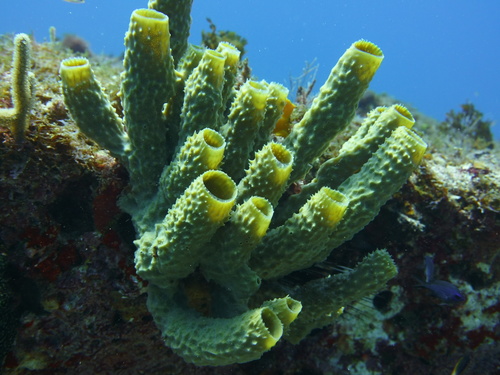
Branching Vase Sponge
Callyspongia aculeata
A masterpiece of biological engineering, the Branching Vase Sponge paints the Caribbean reefs with shades of lavender and violet. These living filters are essential to reef health, providing shelter for a miniature city of marine creatures within their tubular walls.
Quick Identification
Size
Height ranges from 15 to 60 cm (6 to 24 inches), with individual branching tubes typically 2 to 5 cm (0.8 to 2 inches) in diameter.
Colors
Usually shades of lavender, purple, or gray-blue; occasionally found in greenish or brownish hues depending on light exposure and symbiotic algae.
Key Features
- Distinctive tubular or 'vase' branches
- Rough, pitted surface texture with small spines
- Large, visible openings (oscula) at the top of each tube
- Spongy but resilient consistency
When You’ll See Them
Geographic range
Where Does the Branching Vase Sponge Live?
The Branching Vase Sponge is a quintessential inhabitant of the tropical Western Atlantic. Its primary range encompasses the Caribbean Sea, the Bahamas, and the coastal waters of Florida, extending into the Gulf of Mexico. It is also frequently documented along the coast of Brazil and throughout the Greater and Lesser Antilles, flourishing in clear, nutrient-rich waters from the shallows down to the mid-reef slopes.
Basemap © OpenStreetMap contributors
Behavior
The Branching Vase Sponge is a sessile filter feeder, meaning it remains anchored to the reef substrate throughout its adult life. It plays a vital role in the coral reef ecosystem by filtering massive quantities of seawater. Using specialized cells called choanocytes, the sponge creates a current that draws water through tiny pores in its walls, trapping microscopic plankton and organic debris for food before expelling the filtered water through the large openings at the top of its tubes.
While the sponge itself is stationary, it serves as a bustling hub for other marine life. It often shares a symbiotic relationship with various species of brittle stars, which can be seen clinging to its outer surface, and small gobies or shrimp that seek refuge inside its hollow tubes. Unlike many other reef organisms, this sponge does not exhibit complex social behaviors, but its presence is a key indicator of a healthy, functioning reef environment.
EverydayEarth exclusive
Camera Tips
Capturing the Branching Vase Sponge with an underwater or 'backyard reef' camera requires a focus on water clarity and lighting. Since sponges are stationary, the best strategy is to mount your camera on a weighted tripod or a fixed reef structure nearby. To get the best AI recognition, aim for a side-profile shot that captures the distinct tubular 'vase' structure and the large oscula at the top. Avoid placing the camera directly above the sponge, as the top-down view often obscures its identifying shape.
Because these sponges live in depths where red light is quickly absorbed, using a red filter or artificial wide-spectrum video lights is essential to bring out their natural lavender and purple pigments. Without proper lighting, they will appear dull and gray on camera. If you are using a motion-activated system, set the sensitivity to high; while the sponge doesn't move, the AI will likely be triggered by the colorful fish and brittle stars that frequently visit or inhabit the sponge's tubes.
Check your camera lens for 'bio-fouling' (algae or barnacle growth) every few days, as tropical waters promote rapid growth that can blur your footage. Positioning your camera during the mid-morning when the sun is directly overhead provides the best natural ambient light, reducing shadows within the vase tubes and allowing the camera to capture the intricate, pitted texture of the sponge’s skin.
Similar Species
Species that look similar or are commonly confused with Branching Vase Sponge.
Frequently Asked Questions
Record Branching Vase Sponge at your habitat
Connect a camera to start building your own species record — AI identifies every visitor automatically.