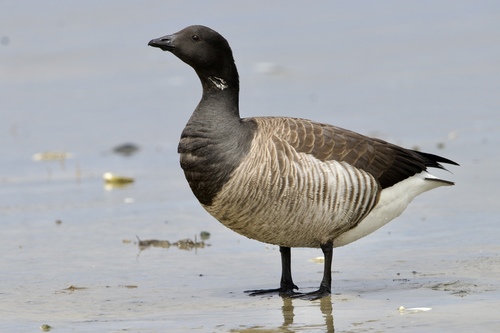
Brant
Branta bernicla
The Brant is the ultimate maritime traveler, an Arctic-breeding goose that spends its winters strictly by the sea. Known for its soft, rolling calls and striking black-and-white neck markings, this small goose is a favorite for coastal birdwatchers.
Quick Identification
Size
Length: 55-66 cm (22-26 in); Wingspan: 110-120 cm (43-47 in); Weight: 0.8-1.8 kg (1.8-4.0 lbs)
Colors
Deep black head, neck, and breast; small white 'necklace' or crescent on the side of the neck; dark grayish-brown back; white rump and under-tail coverts.
Key Features
- Small, duck-sized goose with a short neck and bill
- Distinctive white crescent or 'necklace' on the neck
- Contrast between black breast and lighter belly (except Black Brant subspecies)
- Noisy flocks with a soft, rolling 'rurrp' call
When You’ll See Them
Geographic range
Where Does the Brant Live?
Native to the Northern Hemisphere, the Brant is a circumpolar traveler that spans three continents. These geese breed on the high-Arctic islands and mainland tundras of Canada, Russia, and Greenland. During the winter months, they migrate south to line the Atlantic and Pacific coasts of North America, the shores of Western Europe including the British Isles and the Netherlands, and the coastal regions of East Asia, particularly Japan and Korea.
Basemap © OpenStreetMap contributors
Behavior
During the breeding season, they migrate to the high Arctic, where they nest on the open tundra. In wintering areas, they are constantly active, alternating between swimming and grazing on salt marshes. While they are generally more flighty and wary than Canada Geese, they have become increasingly comfortable in coastal suburban areas, such as waterfront parks and golf courses, where they can be observed grazing on well-manicured lawns near the shore.
EverydayEarth exclusive
Camera Tips
To successfully capture a Brant on your backyard or trail camera, location is everything. Because they are coastal specialists, your camera needs to be positioned within sight of the ocean or a tidal estuary. If you have a backyard that borders a salt marsh or a coastal park, look for areas where the grass is kept short, as Brants love to graze on these 'lawns' during high tide. Place your camera on a low stake or tripod about 12 to 18 inches off the ground to get an intimate, eye-level perspective of these relatively short-statured geese.
Pay close attention to the tide charts when setting your camera's active hours. Brants are most active on land or in shallow water when the tide is transitioning; low tide exposes their favorite eelgrass beds, while high tide often pushes them onto lawns and marshes to graze. If your camera has a time-lapse mode, this can be an excellent way to capture the movement of the flock as they follow the water line throughout the day. Ensure the camera is angled away from the direct glare of the sun reflecting off the water to avoid washed-out images.
Because Brants move in dense groups, use a wide-angle lens setting if your camera allows it, or position the camera further back to capture the social dynamics of the flock. High-speed video is particularly rewarding for this species, as it captures their subtle neck-stretching displays and the constant 'chatter' of the group. If you are in a high-salt environment, remember to use a protective housing or wipe your lens regularly, as salt spray can quickly build up and ruin your shots. No specific bait is needed, but a well-placed camera near a patch of sea lettuce or a manicured coastal lawn is a surefire way to trigger the sensor.
Similar Species
Species that look similar or are commonly confused with Brant.
Canada Goose
Much larger with a prominent white chinstrap and a longer neck; found much further inland.
Cackling Goose
Similar in size but has the 'chinstrap' markings of a Canada Goose and a much shorter, stubbier bill.
Barnacle Goose
Features a white face rather than just a neck patch, and has a silvery-gray back with black bars.
Frequently Asked Questions
Record Brant at your habitat
Connect a camera to start building your own species record — AI identifies every visitor automatically.