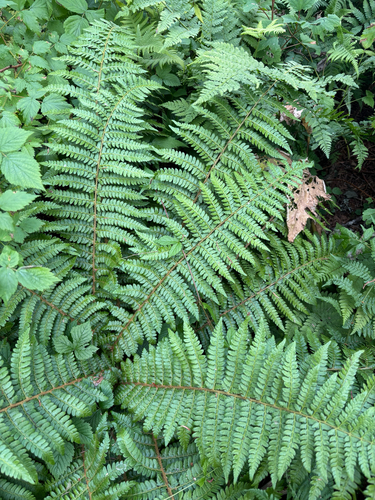
Braun's holly fern
Polystichum braunii
A prehistoric masterpiece of the forest floor, Braun's holly fern is famous for its shaggy, silver-scaled stems and its graceful vase-like silhouette. This ancient plant brings a touch of wild, cool-climate elegance to any shady backyard garden.
Quick Identification
Size
Fronds typically measure 12-36 inches (30-90 cm) in length and 3-6 inches (8-15 cm) in width.
Colors
Lustrous dark forest green fronds with prominent silvery-brown or golden scales along the stalk (rachis).
Key Features
- Distinctive vase-shaped or 'shuttlecock' growth habit
- Bipinnate (twice-divided) fronds with a glossy texture
- Stems and fiddleheads densely covered in shaggy, silvery-brown scales
- Rectangular or rhombic leaflets (pinnules) with bristly tips
- Semi-evergreen foliage that persists into early winter
When You’ll See Them
Geographic range
Where Does the Braun's holly fern Live?
Braun's holly fern possesses a broad but patchy circumboreal distribution across the Northern Hemisphere. In North America, its range is split between the cool, humid forests of the Pacific Northwest (from Alaska down to Washington) and the northeastern regions, including the Great Lakes, New England, and the Canadian Maritimes. Beyond North America, it is native to northern and central Europe as well as temperate regions of East Asia, including Japan and China, where it consistently seeks out high-moisture mountain or coastal environments.
Basemap © OpenStreetMap contributors
Behavior
Braun's holly fern is a slow-growing perennial characterized by its elegant, symmetrical crown. In early spring, it exhibits a striking 'behavior' as its fiddleheads emerge from the soil. These young fronds are heavily protected by a thick coat of white or silvery scales, which serve as insulation against late frosts. As the fronds unfurl, they form a classic vase shape that can reach nearly three feet in height in ideal conditions.
While it does not move like an animal, this fern is highly responsive to its environment. It thrives in high-humidity microclimates and acts as a natural indicator of ancient, undisturbed woodland soil. It does not spread aggressively through rhizomes; instead, it remains in tidy, localized clumps, making it a non-invasive and peaceful neighbor for other woodland flora. For wildlife, the dense fronds provide excellent low-level cover for ground-nesting insects and small amphibians.
EverydayEarth exclusive
Camera Tips
To capture the stunning architectural detail of Braun's holly fern, focus your camera on the crown of the plant during late April and May. This is when the 'shaggy' fiddleheads emerge. Use a low-angle placement, roughly 6 to 10 inches from the ground, tilted slightly upward to emphasize the scale and texture of the silver-brown fuzz covering the new growth. If your camera has a macro mode, this is the perfect time to use it.
Since ferns don't trigger traditional motion sensors, use your camera's time-lapse function. Set the camera to take a photo every 4 to 6 hours over a two-week period during the spring unfurling. This will create a spectacular visual record of the fronds expanding into their vase shape. Avoid using a flash if possible, as the reflective scales on the stem can cause significant 'white-out' glare; instead, rely on the soft, dappled morning light common in its forest habitat.
For year-round monitoring, position the camera to capture the fern's interaction with the changing seasons. In late autumn, you can document the 'collapse' of the fronds, which often stay green even under a light dusting of snow. Ensure your camera is well-anchored to a nearby tree or a heavy stake, as the moist, rocky ground where these ferns grow can be unstable during spring thaws.
Similar Species
Species that look similar or are commonly confused with Braun's holly fern.
Christmas Fern
Christmas fern has simple, once-divided leaflets shaped like a 'stocking,' whereas Braun's is twice-divided and much more textured.
Northern Holly Fern
Northern Holly Fern is smaller, lacks the twice-divided fronds, and is usually found in much harsher, alpine rocky crevices.
Ostrich Fern
Ostrich fern lacks the heavy silvery scales on the stem and has a much more plume-like, feathery texture compared to the glossy Braun's holly fern.
Frequently Asked Questions
Record Braun's holly fern at your habitat
Connect a camera to start building your own species record — AI identifies every visitor automatically.