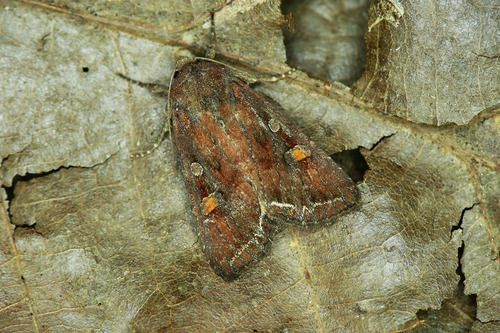
Bright-line Brown-eye
Lacanobia oleracea
A common but beautiful garden visitor, the Bright-line Brown-eye is easily identified by its striking white 'W' marking and warm russet tones. It is a master of the night, fluttering through backyards across Eurasia in search of nectar.
Quick Identification
Size
Wingspan of 34–45 mm (1.3–1.8 inches)
Colors
Forewings are typically a rich reddish-brown or russet, featuring a prominent white subterminal line and an orange-tinted kidney-shaped spot.
Key Features
- Distinctive white subterminal line forming a 'W' shape
- Orange-brown reniform stigma (the 'brown-eye')
- Reddish-brown to dark brown forewings
- Greyish-white hindwings with darker veins
When You’ll See Them
Geographic range
Where Does the Bright-line Brown-eye Live?
This moth is a widespread resident across the temperate regions of the Palearctic. It is found throughout Europe and North Africa, stretching across Central Asia into northern India, China, Korea, and Japan. Because it thrives in human-altered landscapes, it has maintained a stable and robust presence across its entire native range.
Basemap © OpenStreetMap contributors
Behavior
The Bright-line Brown-eye is a common and highly adaptable moth that is a frequent visitor to suburban gardens and agricultural land. As a nocturnal species, it spends its daylight hours resting in a state of torpor, perfectly camouflaged against tree bark or within dense foliage. It becomes active at dusk, taking flight to seek out nectar-rich flowers or to find a mate.
This moth is particularly well-known for its larval stage; the caterpillars are generalist feeders and can be found on a vast array of host plants. While they are usually solitary, they can occasionally be found in greenhouses where they are sometimes considered a minor pest. In the wild, they play a crucial role in the food web, serving as a primary food source for bats, birds, and small mammals during the spring and summer months.
EverydayEarth exclusive
Camera Tips
To capture the Bright-line Brown-eye on your backyard camera, you need to leverage its nocturnal habits. Since these moths are strongly attracted to light, placing your camera near an outdoor LED light or a specialized moth trap is the most effective strategy. Ensure your camera's infrared (IR) night vision is active, as this will illuminate the moth's reflective wing patterns without startling it. Set your camera to a high sensitivity to trigger even for small movements.
Another excellent method is to use a sugary lure, often called 'moth sugar' or 'wine roping.' Mix brown sugar, molasses, and fermented fruit or beer into a thick paste and brush it onto a tree trunk or a wooden post within view of your camera. Position the camera approximately 0.5 to 1 meter (2-3 feet) away to get clear, high-resolution shots of the moth as it lands to feed. The 'bright-line' and 'brown-eye' markings are most visible when the moth is at rest with its wings flat.
Focus your efforts during the peak flight seasons, which typically occur in two waves: one from May to June and another from August to September. Clear, humid nights with little wind provide the best conditions for moth activity. If your camera allows for macro-focusing, try to narrow the field of view to a specific flower or bait patch to capture the intricate details of the wing venation and the signature orange spot.
Similar Species
Species that look similar or are commonly confused with Bright-line Brown-eye.
Frequently Asked Questions
Record Bright-line Brown-eye at your habitat
Connect a camera to start building your own species record — AI identifies every visitor automatically.