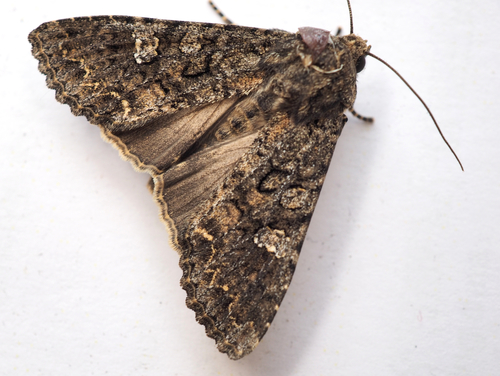
Cabbage Moth
Mamestra brassicae
A master of nocturnal camouflage, the Cabbage Moth is a resilient and highly adaptable visitor to backyards across Europe and Asia. Recognizable by the distinct white kidney-shaped mark on its dark wings, this moth is a fascinating study in survival and agricultural history.
Quick Identification
Size
Wingspan of 34–50 mm (1.3–2 inches); body length approximately 15–22 mm (0.6–0.9 inches)
Colors
Mottled dark brown to greyish-black forewings; distinct white-outlined kidney-shaped mark (stigma); pale grey hindwings with darker veining
Key Features
- White kidney-shaped spot on the forewing
- Prominent spur on the tibia of the front leg
- Mottled brown-grey camouflage pattern
- Wavy white subterminal line on the forewing
When You’ll See Them
Geographic range
Where Does the Cabbage Moth Live?
Native to the Palearctic realm, the Cabbage Moth is widely distributed across the entire European continent and extends through temperate Asia to Japan. It is a common resident from the British Isles across the Mediterranean and into the Russian steppes, thriving wherever human agriculture provides a steady supply of host plants. While mostly an Old World species, its adaptability allows it to maintain high populations in both rural and suburban landscapes.
Basemap © OpenStreetMap contributors
Behavior
The Cabbage Moth is a master of nocturnal survival, spending the daylight hours perfectly still against tree bark, wooden fences, or within dense foliage where its mottled wings provide expert camouflage. Once night falls, these moths emerge to feed on nectar and search for mates. They are strong flyers, capable of traveling significant distances to find the specific host plants required for their offspring.
Unlike many other moth species that are solitary and scattered, Cabbage Moths can occur in high densities in areas with abundant food sources. Females are particularly methodical, using sensitive antennae to detect chemical signatures of host plants like brassicas. They typically lay their eggs in neat clusters on the undersides of leaves to shield them from the sun and predators, ensuring the next generation has immediate access to food upon hatching.
EverydayEarth exclusive
Camera Tips
To successfully capture the Cabbage Moth on your backyard AI camera, focus your efforts on the 'lure and wait' strategy. Since these moths are strictly nocturnal, you will need a camera with high-quality infrared (IR) night vision. Position your camera near a patch of cabbage, kale, or flowering nectar sources like Buddleia or Honeysuckle. Mounting the camera at a height of 2 to 4 feet, angled slightly downward toward the leaves, will provide the best angle for catching them as they land to feed or oviposit.
One of the best ways to bring this species into focus is to use a 'sugar lick.' Mix brown sugar, overripe bananas, and a splash of dark beer into a thick paste and smear it on a tree trunk or post within the camera's field of view. The fermenting scent is irresistible to Cabbage Moths. Set your AI camera to its highest sensitivity and use a 'burst' or 'photo-first' mode; moths move quickly, and capturing multiple frames ensures you get a crisp shot of the diagnostic white wing spots rather than a blurry streak.
Pay close attention to the weather. Cabbage Moths are most active on warm, overcast, and still nights. If it is windy or raining, they tend to stay tucked away in the undergrowth. In temperate zones, the best time for recording is during their two peak generations—the first in late spring (May/June) and the second, often larger, generation in late summer (August/September). Keep your camera lens free of cobwebs, as the IR light can reflect off them and wash out the image of a small, dark insect.
Similar Species
Species that look similar or are commonly confused with Cabbage Moth.
Frequently Asked Questions
Record Cabbage Moth at your habitat
Connect a camera to start building your own species record — AI identifies every visitor automatically.