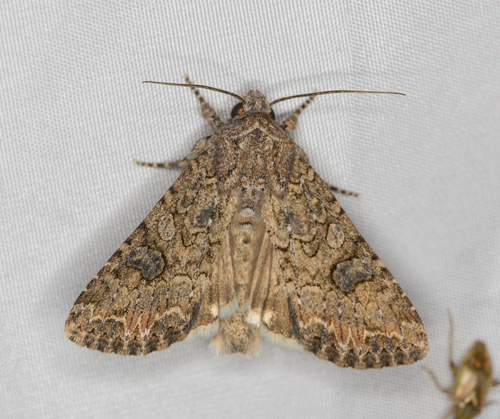
Nutmeg Moth
Anarta trifolii
A master of midnight camouflage, the Nutmeg moth is a subtle beauty that hides in plain sight among our gardens and grasslands.
Quick Identification
Size
Wingspan of 30–39 mm (1.2–1.5 inches); body length approximately 15–18 mm (0.6–0.7 inches)
Colors
Mottled greyish-brown to reddish-brown forewings; hindwings are light grey with a broad, smoky dark border and distinct darker veins.
Key Features
- Distinct 'W' shape on the pale subterminal line near the wing edge
- Kidney-shaped (reniform) spot with a characteristic dark smudge in the lower half
- Mottled, camouflaged appearance resembling bark or dried earth
- Small, pale circular (orbicular) spot near the wing base
When You’ll See Them
Geographic range
Where Does the Nutmeg Moth Live?
The Nutmeg moth is a true Holarctic traveler, native to a vast stretch of the Northern Hemisphere. It is found across the entirety of Europe and North Africa, stretching eastward through Central Asia to Japan. In North America, its range is equally impressive, spanning from southern Canada through the United States and into parts of northern Mexico, making it one of the most widely distributed noctuid moths in temperate regions.
Basemap © OpenStreetMap contributors
Behavior
The Nutmeg moth is a primarily nocturnal flyer, though it is occasionally flushed from low vegetation during the day. Like many members of the Noctuidae family, it spends its daylight hours perfectly camouflaged against tree bark or wooden fences, where its mottled brown wings make it nearly invisible to predators like birds. Once darkness falls, it becomes highly active, seeking out nectar-rich flowers and mates.
This species is well-known for its attraction to artificial light sources, a trait that makes it a frequent visitor to porch lights and garden moth traps. It typically produces two or three generations per year in warmer climates, meaning it can be spotted throughout most of the growing season. While the adults are harmless pollinators, the larvae—known as clover cutworms—can sometimes be found in large numbers on their favorite food plants, though they rarely reach pest status in a balanced backyard ecosystem.
EverydayEarth exclusive
Camera Tips
To capture high-quality images of the Nutmeg moth, you need to leverage its natural attraction to light. Setting up a white sheet with a bright UV or mercury vapor lamp nearby is the gold standard; the moth will land on the sheet and remain still, allowing your camera to focus on its intricate wing patterns. If you are using a fixed AI-powered backyard camera, position it near a wall or fence that is illuminated by soft outdoor lighting.
Because these moths are small and rely on camouflage, use a macro lens or a camera with a short focal distance. If your camera has a 'night mode' that uses infrared, you may capture their activity, but the subtle brown and grey markings that distinguish the Nutmeg from other similar species are best seen in full color. Try to trigger the camera with a motion sensor set to high sensitivity, as their fluttering can be quite rapid.
Another effective strategy is 'sugar coding.' Brush a mixture of fermented fruit, brown sugar, and dark beer onto a tree trunk at eye level. Check this station with your camera after dark. Nutmeg moths are frequent visitors to these sweet lures. Position your camera about 12-18 inches from the bait for the best detail. Peak activity typically occurs on warm, overcast nights with little wind, so monitor the weather for the best opportunities.
Similar Species
Species that look similar or are commonly confused with Nutmeg Moth.
Frequently Asked Questions
Record Nutmeg Moth at your habitat
Connect a camera to start building your own species record — AI identifies every visitor automatically.