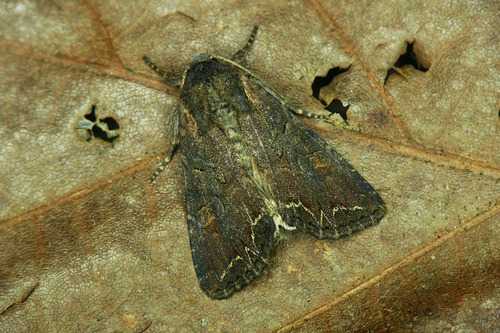
Dog's Tooth
Lacanobia suasa
A master of nocturnal disguise, the Dog's Tooth moth is named for the sharp 'W' shape on its wings. This common Palearctic visitor is a favorite for backyard naturalists using light-based observation.
Quick Identification
Size
Wingspan of 32-44 mm (1.25-1.75 inches); body length approximately 15-20 mm (0.6-0.8 inches).
Colors
Primary colors include mottled shades of brown, grey, and reddish-tan. The wings feature a prominent pale subterminal line and distinct kidney-shaped markings.
Key Features
- Distinctive white 'W' mark (the 'dog's tooth') on the subterminal wing line
- Mottled brown forewings with visible oval and kidney-shaped spots
- Resting posture with wings folded flat over the abdomen
- Double-brooded appearance in early and late summer
When You’ll See Them
Geographic range
Where Does the Dog's Tooth Live?
The Dog's Tooth is a widespread resident of the Palearctic realm, with a native range that spans the entirety of Europe and across temperate Asia to Japan. It is particularly well-established in the United Kingdom, Scandinavia, and Central Europe, where it thrives in both coastal and inland environments. While it has not been introduced to North America, its ability to adapt to varied climates allows it to maintain high population densities across the Russian steppe and into Northern China.
Basemap © OpenStreetMap contributors
Behavior
The Dog's Tooth is a nocturnal strategist, spending its daylight hours perfectly still and camouflaged against tree bark, fence posts, or leaf litter. Its intricate wing patterns allow it to blend into textured surfaces, making it nearly invisible to birds and other predators. As dusk falls, the moth becomes active, taking flight to feed on nectar and seek out mates.
In the garden environment, this species is known for its strong attraction to artificial light sources. It is a common visitor to porch lights and windows, often seen fluttering erratically before settling. Unlike some more skittish species, once the Dog's Tooth finds a resting spot near a light, it often remains stationary for long periods, allowing for excellent observation and photography. During the caterpillar stage, they are solitary feeders, emerging at night to munch on various low-growing vegetation.
EverydayEarth exclusive
Camera Tips
Capturing the Dog's Tooth on a wildlife camera requires a specialized approach since most standard trail cameras are designed for larger mammals. The most effective method is to use a camera with macro capabilities or a dedicated 'moth trap' setup. Position your camera facing a white sheet that is illuminated by a UV or mercury vapor lamp. The Dog's Tooth is highly phototropic and will land on the sheet, providing a stable, high-contrast background for your photos.
If you prefer a more natural look, use 'sugaring' to lure them. Mix dark brown sugar, a splash of beer, and overripe bananas into a thick paste and paint it onto a tree trunk at eye level. Set your camera on a tripod just a few feet away. Because these moths are small, you will need to ensure your camera's focus is locked to the specific patch of bait. Use a fast shutter speed or a diffused flash to freeze their wing movement, as they often vibrate their wings while feeding to maintain body temperature.
Timing is critical for this species. They are double-brooded, meaning they have two flight windows: one in late spring and another in late summer. Aim for warm, humid nights with heavy cloud cover, as these conditions are when the Dog's Tooth is most active. Avoid windy nights, as the moths will stay low in the vegetation to avoid being blown off course. For the best AI detection, ensure the camera is positioned to capture the dorsal (top) view of the wings where the 'dog's tooth' mark is most visible.
Similar Species
Species that look similar or are commonly confused with Dog's Tooth.
Frequently Asked Questions
Record Dog's Tooth at your habitat
Connect a camera to start building your own species record — AI identifies every visitor automatically.