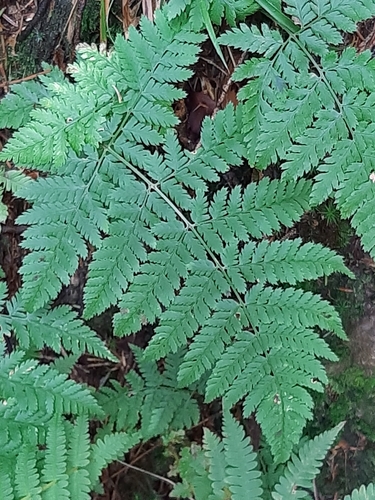
broad buckler-fern
Dryopteris dilatata
A robust titan of the shade, the broad buckler-fern transforms dark garden corners into lush woodland retreats with its intricate, lacy fronds and architectural elegance.
Quick Identification
Size
Height up to 90 cm (35 in); spread up to 120 cm (47 in)
Colors
Deep dark green fronds; leaf stalks (stipes) covered in pale brown scales with a distinct dark brown or blackish central stripe
Key Features
- Broad, arching tripinnate fronds with a lacy, intricate appearance
- Large, robust scales on the stipe featuring a dark central 'midrib'
- Triangular or pentagonal-shaped lower pinnae
- Dense, clump-forming growth habit creating a shuttlecock shape
When You’ll See Them
Geographic range
Where Does the broad buckler-fern Live?
This hardy fern is native across the European continent, showing its greatest density in the temperate forests of Western and Central Europe. Its range extends north into Scandinavia and south into the mountainous regions of the Mediterranean, reaching eastward as far as the lush corridors between the Black and Caspian Seas. It is a quintessential species of the Atlantic and Continental climate zones, thriving in areas with consistent moisture.
Basemap © OpenStreetMap contributors
Behavior
The broad buckler-fern is a resilient and structurally impressive perennial that serves as a cornerstone of the woodland understory. Growing from a stout, semi-erect rhizome, it produces a majestic crown of arching fronds. While it is technically deciduous, in sheltered gardens and mild coastal climates, it often remains semi-evergreen, holding its dark green color well into the winter months before finally collapsing to make room for new growth.
Unlike many other fern species that spread aggressively through underground runners, the broad buckler-fern is a 'clumper.' It expands slowly from its central base, making it a predictable and well-behaved resident of backyard shade gardens. It interacts with its environment by providing a cool, moist microclimate beneath its wide canopy, which is essential for various soil-dwelling invertebrates and amphibians.
EverydayEarth exclusive
Camera Tips
Capturing the broad buckler-fern effectively requires a focus on its architectural form and seasonal transitions. To highlight its iconic 'shuttlecock' shape, place your camera on a low mount about 30 cm from the ground, angled slightly upward. This perspective emphasizes the height of the fronds and the textured, scaly base of the plant. Because these ferns thrive in deep shade, ensure your camera settings are optimized for low light, or use a model with a high-sensitivity sensor to capture the rich greens without excessive digital noise.
The most rewarding way to document this species is through time-lapse photography during the spring 'unfurling' season. Between late March and May, set your camera to take a photo every 2 to 4 hours. You will capture the mesmerizing movement of the croziers (fiddleheads) as they expand and flatten into mature fronds—a process that is surprisingly dynamic when sped up. This unique footage is a great way to showcase the plant's life cycle on your EverydayEarth feed.
During the summer and autumn, use the broad buckler-fern as a 'natural blind' for wildlife photography. Small mammals like voles, shrews, and even hedgehogs frequently use the dense canopy of this fern for cover. By aiming your camera at the dark, sheltered space directly beneath the arching fronds, you are much more likely to catch candid shots of shy backyard critters that feel safe in the fern's shadow. In winter, the decaying fronds provide a textured, copper-colored backdrop that can make winter birds or squirrels pop in your images.
Similar Species
Species that look similar or are commonly confused with broad buckler-fern.
Frequently Asked Questions
Record broad buckler-fern at your habitat
Connect a camera to start building your own species record — AI identifies every visitor automatically.