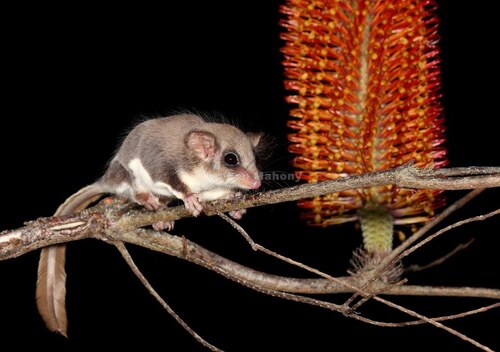
Broad-toed Feather-tailed Glider
Acrobates frontalis
The world's smallest gliding mammal is a hidden gem of the Australian night, sporting a unique 'feathered' tail and the ability to soar through the treetops. These tiny acrobats are proof that some of the most spectacular wildlife lives right in our own backyards.
Quick Identification
Size
Body length 6.5-8 cm (2.5-3.1 in), tail length 7-8 cm (2.7-3.1 in), weighing only 10-15g (0.35-0.53 oz)
Colors
Olive-brown to grey-brown upper parts with a clean creamy-white underbelly and prominent dark eye-rings
Key Features
- Distinctive flat tail with stiff hairs arranged like a bird's feather
- Ultra-miniature size, roughly the scale of a large thumb
- Skin membrane (patagium) for gliding reaching from elbows to knees
- Wide, serrated toe pads for climbing smooth-barked trees
When You’ll See Them
Geographic range
Where Does the Broad-toed Feather-tailed Glider Live?
Native to the eastern coast of Australia, the Broad-toed Feather-tailed Glider is found from northern Queensland down through New South Wales and into Victoria. This species occupies the humid and sub-humid zones of the Great Dividing Range, thriving in areas where mature native trees provide both hollows for nesting and a steady supply of nectar. They are most densely populated in the coastal forests of the eastern seaboard, where the climate remains relatively stable year-round.
Basemap © OpenStreetMap contributors
Behavior
The Broad-toed Feather-tailed Glider is a marvel of social engineering and agility. These tiny marsupials are known to live in communal groups of up to 30 individuals, huddling together in spherical nests lined with eucalyptus leaves to maintain body temperature. During periods of extreme cold or food scarcity, they can enter a state of torpor, lowering their body temperature and metabolic rate for several days to conserve energy.
As nocturnal acrobats, they spend their nights navigating the high canopy with surprising speed. They don't just climb; they leap and glide, using their feather-like tail as a rudder to steer through the air for distances up to 25 meters. Despite their shy nature, they are highly active foragers, constantly moving between blossom-filled trees with a jittery, nervous energy that makes them a challenge to spot with the naked eye.
EverydayEarth exclusive
Camera Tips
Capturing the Broad-toed Feather-tailed Glider on camera is a rewarding challenge due to their minuscule size and high-canopy lifestyle. To get high-quality images, mount your camera at least 2 to 3 meters up a vertical trunk, ideally on a tree currently in bloom, such as a Banksia or a flowering Eucalyptus. Because they are so small, you need to bring the subject to the camera; focus your lens on a specific branch or a 'glider pole' and ensure the camera is positioned within 1 to 1.5 meters of the target area to maintain detail.
Baiting is highly effective for this species. Use a spray bottle to mist a 'nectar' solution—a mix of water and honey or specialized lorikeet nectar powder—directly onto the bark of the tree within the camera's field of view. The gliders will spend several minutes licking the nectar, providing ample time for the sensor to trigger and capture clear shots. Avoid using white flash, which can 'wash out' their small frames and startle them; instead, use high-quality 'No-Glow' or black infrared LEDs which are invisible to the animals.
Given their lightning-fast movements, set your camera to a high-speed burst mode (3-5 photos per trigger) or short 10-20 second video clips. If your camera allows for sensitivity adjustments, set the PIR sensor to 'High' to ensure it detects these feather-weight mammals. In backyard settings, place the camera near established nesting boxes or along 'commuter' routes—thin branches that connect one tree canopy to another.
Similar Species
Species that look similar or are commonly confused with Broad-toed Feather-tailed Glider.
Narrow-toed Feather-tailed Glider
Nearly identical in appearance but found more commonly in southern Australia; requires a close look at the toe pads and grooming claws to distinguish.
Sugar Glider
Significantly larger with a bushy tail and a prominent dark stripe running from the nose to the mid-back.
Frequently Asked Questions
Record Broad-toed Feather-tailed Glider at your habitat
Connect a camera to start building your own species record — AI identifies every visitor automatically.