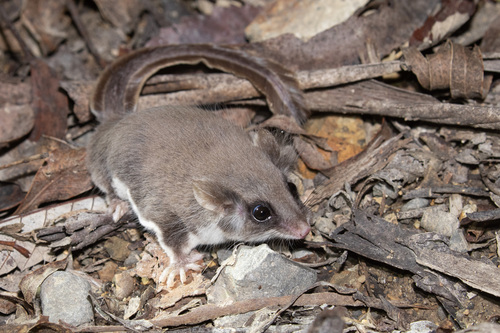
Narrow-toed Feather-tailed Glider
Acrobates pygmaeus
Meet the world's smallest gliding mammal, a tiny marvel with a tail like a feather and a leap that defies its size. This elusive 'flying mouse' is a master of the Australian canopy, darting through the blossoms of your backyard under the cover of darkness.
Quick Identification
Size
6.5–8 cm (2.5–3.1 in) body length; tail 7–8 cm (2.8–3.1 in); weight 10–14 g (0.35–0.5 oz)
Colors
Soft grey-brown upperparts, creamy-white underbelly, and dark rings around the eyes.
Key Features
- Feather-like tail with stiff hairs on both sides
- Smallest gliding mammal in the world
- Narrow gliding membrane (patagium) extending from elbow to knee
When You’ll See Them
Geographic range
Where Does the Narrow-toed Feather-tailed Glider Live?
The Narrow-toed Feather-tailed Glider is native to the eastern half of Australia. Its range forms a wide, continuous arc from the tip of the Cape York Peninsula in northern Queensland, down through the coastal and sub-coastal regions of New South Wales and Victoria, and into the south-eastern corner of South Australia. While it is most abundant in dense eucalypt forests, it has adapted well to fragmented landscapes and can be found in urban parks and leafy suburban backyards throughout the Australian east coast.
Basemap © OpenStreetMap contributors
Behavior
The Narrow-toed Feather-tailed Glider is an incredibly energetic and social marsupial. Despite being the size of a mouse, these gliders live in communal groups of up to 40 individuals, often huddling together in tree hollows or nesting boxes to conserve body heat. During periods of extreme cold or food scarcity, they can enter a state of torpor, where their body temperature drops and their metabolism slows significantly to survive the night.
In the canopy, they move with a frantic, darting agility. They are capable of gliding up to 25 meters to move between trees, using their unique feather-shaped tail as a rudder to steer and stabilize their flight. While they are shy and strictly nocturnal, they are remarkably bold when feeding, often returning to the same flowering trees night after night, making them a delight for patient wildlife observers.
EverydayEarth exclusive
Camera Tips
Because the Narrow-toed Feather-tailed Glider is so small, standard trail camera setups often fail to trigger. To capture them, you need to bring the action to the camera. Mount your device 2 to 4 meters up the trunk of a mature flowering tree, such as a Eucalyptus, Banksia, or Bottlebrush. Use a mounting bracket that allows you to angle the camera slightly downward toward a specific branch or a cluster of blossoms. If your camera has a 'Macro' mode or adjustable focus, set it for a short distance (1–2 meters), as these tiny creatures won't show much detail from further away.
Baiting is the secret to success with this species. Create a 'honey-water' spray (diluted honey or maple syrup) and apply it liberally to the bark directly in front of the lens. Alternatively, secure a small piece of sponge or cotton wool soaked in honey-water to a branch. This will encourage the gliders to linger in the frame as they lap up the nectar. Because they are lightning-fast, set your camera to 'Burst Mode' (3–5 photos per trigger) or short, high-resolution video clips (10–15 seconds) with a zero-second trigger delay.
Since they are strictly nocturnal, your camera’s infrared (IR) performance is critical. 'No-Glow' IR is preferred to avoid spooking the animals, though they are generally less sensitive to light than larger mammals. Check your camera weekly during the spring and autumn when native trees are in peak bloom, as this is when the gliders are most active. If you have nest boxes in your yard, pointing a camera at the entrance hole during the hour after sunset is an excellent way to capture them beginning their nightly forage.
Similar Species
Species that look similar or are commonly confused with Narrow-toed Feather-tailed Glider.
Frequently Asked Questions
Record Narrow-toed Feather-tailed Glider at your habitat
Connect a camera to start building your own species record — AI identifies every visitor automatically.