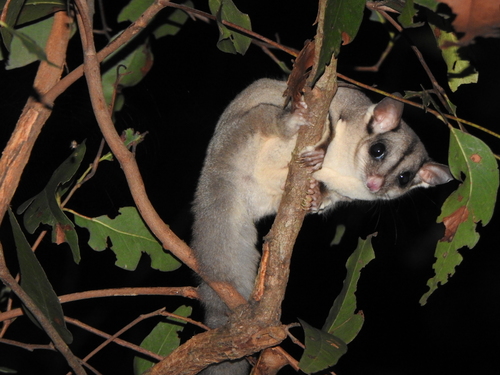
Sugar Glider
Petaurus breviceps
The Sugar Glider is nature's tiny base jumper, a palm-sized marsupial that navigates the forest canopy with built-in wings and a sweet tooth for nectar.
Quick Identification
Size
Body length of 12-15 cm (5-6 in) with a tail of 15-21 cm (6-8 in); weighs between 80-160 g (2.8-5.6 oz).
Colors
Blue-grey fur on the back with a prominent black stripe from nose to mid-back; underside is cream or pale grey.
Key Features
- Distinctive black stripe running from the nose to the base of the tail
- Gliding membrane (patagium) extending from the fifth finger to the first toe
- Large, dark, bulbous eyes for night vision
- Long, bushy prehensile tail used for stability and carrying nesting materials
When You’ll See Them
Geographic range
Where Does the Sugar Glider Live?
Sugar Gliders are native to the eastern and northern stretches of mainland Australia, as well as New Guinea and several surrounding islands such as the Bismarck Archipelago and the Louisiade Archipelago. They are widely distributed across the Australian states of Queensland, New South Wales, Victoria, and parts of South Australia and the Northern Territory. Additionally, they were introduced to Tasmania in the 1830s, where they have since established a significant and widespread population throughout the island's forests.
Basemap © OpenStreetMap contributors
Behavior
Sugar Gliders are highly social, arboreal marsupials that live in family groups of up to ten adults. They are famous for their ability to glide up to 50 meters (164 feet) between trees using a specialized fold of skin called a patagium. During the day, they huddle together in tree hollows lined with leaves to conserve heat, especially during colder months when they may enter a state of temporary hibernation known as torpor.
In the wild, they are vocal and communicative, using a range of barks, hisses, and chirps to signal alarm or maintain social bonds. While they are naturally shy around humans, they are frequent visitors to suburban backyards that provide mature flowering trees. Their nocturnal lifestyle means they are rarely seen during the day, but their presence is often given away by their distinct 'yip-yip' barking calls at night.
EverydayEarth exclusive
Camera Tips
To capture Sugar Gliders on camera, height is your best friend. These animals rarely descend to the ground, so you should mount your camera 2 to 4 meters (6-13 feet) up a tree trunk. Look for 'feed trees'—specifically mature eucalypts or acacias that show signs of scarring on the bark where gliders have been chewing to access sap. Angling the camera slightly downward along a main branch or directly across a trunk will yield the best results.
The most effective way to lure them into frame is using a 'honey lick.' Mix equal parts honey and water (or use a seedless fruit jam) and spray or smear it directly onto the bark in the camera's field of view. Because they are tiny and fast, set your camera to its most sensitive trigger speed and use 'Burst Mode' to capture 3-5 photos per trigger. Video mode is even better, as it allows you to see their social interactions and grooming behavior, which are highlights of this species.
Since they are strictly nocturnal, a high-quality infrared (no-glow) flash is essential to avoid startling them. Standard white flashes may cause them to flee and not return to the bait. During winter, they are often more desperate for high-energy food, making this the peak time for camera trapping as they are more likely to spend extended periods at your bait station.
Finally, keep an eye on the weather. Sugar Gliders are less active during heavy rain or high winds, as these conditions make gliding dangerous. Calm, clear nights following a period of rain are often the most productive, as the gliders emerge to feed on the fresh nectar and sap produced by the trees.
Similar Species
Species that look similar or are commonly confused with Sugar Glider.
Frequently Asked Questions
Record Sugar Glider at your habitat
Connect a camera to start building your own species record — AI identifies every visitor automatically.