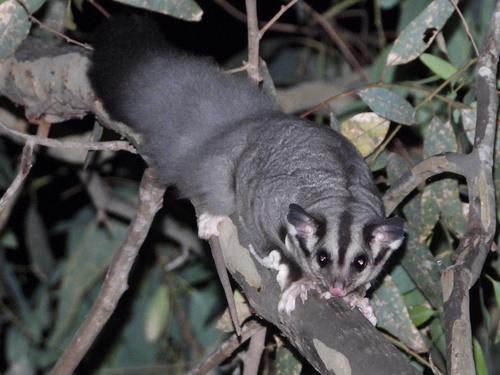
Squirrel Glider
Petaurus norfolcensis
With a tail as bushy as a squirrel's and the ability to soar through the night sky, the Squirrel Glider is one of Australia's most enchanting nocturnal acrobats. Discover how to spot this elusive forest dweller in your own backyard.
Quick Identification
Size
Head and body 18–23 cm (7–9 in); tail 22–33 cm (8.5–13 in); weight 190–300 g (6.7–10.6 oz)
Colors
Soft blue-grey fur above, white to creamy-yellow belly, bold black stripe from forehead to tail base, and a very bushy dark tail
Key Features
- Extremely bushy tail that is wider at the base than the tip
- Distinctive black dorsal stripe running from nose to mid-back
- Gliding membrane (patagium) extending from wrists to ankles
- Pointed face with large, nocturnal eyes
When You’ll See Them
Geographic range
Where Does the Squirrel Glider Live?
The squirrel glider is native to the eastern coast and inland regions of Australia, stretching from northern Queensland down through New South Wales and into Victoria. They are primarily found along the Great Dividing Range and coastal lowlands, though their populations have become increasingly fragmented in the south due to urban development. They are a strictly Australian species and have no introduced populations elsewhere in the world.
Basemap © OpenStreetMap contributors
Behavior
Squirrel gliders are remarkably agile nocturnal marsupials that spend their nights navigating the forest canopy. They live in small family groups, often consisting of one adult male and several females with their offspring, sharing a tree hollow lined with fresh eucalypt leaves for warmth and protection. While they are capable of gliding over 50 meters in a single leap, they are generally shy and avoid coming to the ground where they are vulnerable to predators like foxes and domestic cats.
These gliders communicate through a variety of vocalizations, ranging from soft chattering and nasal 'whirrs' while feeding to loud, guttural shrieks that can be quite startling when heard in the dark. In suburban areas, they may visit gardens with mature flowering trees, though they are much more cautious than their smaller cousins, the sugar gliders. They are highly territorial and will defend their home range against intruders of the same species.
EverydayEarth exclusive
Camera Tips
To capture high-quality footage of Squirrel Gliders, placement is everything. Position your camera 3 to 5 meters up a mature tree, ideally one with a known sap site (look for 'V' shaped notches in the bark) or near a hollow entrance. Use a mounting strap that doesn't damage the tree and angle the lens slightly downward to catch them as they climb or feed. Because they are strictly nocturnal, a camera with a high-quality 'no-glow' infrared flash is essential to avoid startling them or blowing out the image details with white light.
You can encourage gliders to visit a specific spot by creating a 'station' using a mixture of honey and water, or specialized nectar mix, painted directly onto the bark or placed in a small, elevated feeder. Be sure to position the camera about 1.5 to 2 meters away from the bait to ensure the animal is in focus. Setting your camera to 'Video Mode' is highly recommended over still photos, as gliders move very quickly and a single photo often results in just a blurry tail or a pair of glowing eyes.
The best time to observe them is during the flowering season of local Eucalypt, Banksia, or Acacia species, as gliders will be more active and focused on feeding. In your backyard, target trees near the fence line or those that form a continuous canopy, as gliders prefer to stay high and avoid open gaps. Check your batteries frequently; cold nights can drain them faster, and you don't want to miss a rare gliding shot because of a dead power source. If your camera has a sensitive trigger speed, aim it at a landing spot on a trunk rather than into thin air to catch the moment they land after a glide.
Similar Species
Species that look similar or are commonly confused with Squirrel Glider.
Sugar Glider
Smaller in size with a less bushy tail and a greyish-white belly instead of pure white or cream.
Yellow-bellied Glider
Much larger with a distinctive yellow or orange belly and very large, bare ears.
Mahogany Glider
Larger and browner in color, with a range restricted to a very small area of North Queensland.
Frequently Asked Questions
Record Squirrel Glider at your habitat
Connect a camera to start building your own species record — AI identifies every visitor automatically.