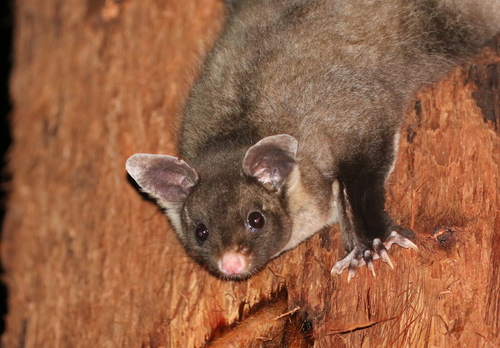
Yellow-bellied Glider
Petaurus australis
With its acrobatic leaps and haunting night-time shrieks, the Yellow-bellied Glider is the undisputed star of Australia's tall forests. This fluffy, sap-loving marsupial is a master of the canopy, capable of gliding the length of a football field in a single bound.
Quick Identification
Size
Head-body length 27–30 cm (10.6–11.8 in), tail 42–48 cm (16.5–18.9 in), weighing 450–700 g (1–1.5 lbs)
Colors
Grey-brown upperparts, creamy-white to vivid orange-yellow belly (brightens with age), dark stripe down the back, black ears and feet.
Key Features
- Large, pointed, hairless ears
- Extremely long, bushy tail
- Characteristic V-shaped feeding scars on eucalypt trunks
- Furry gliding membrane extending from wrist to ankle
When You’ll See Them
Geographic range
Where Does the Yellow-bellied Glider Live?
Native to the continent of Australia, the Yellow-bellied Glider occupies a long, narrow strip of temperate and subtropical forest along the eastern seaboard. Its range stretches from the tropical reaches of North Queensland down through New South Wales and into the cooler forests of central and southern Victoria. While they were once more widespread, they are now primarily found in high-rainfall areas where old-growth trees provide the large hollows they need for nesting and survival.
Basemap © OpenStreetMap contributors
Behavior
The Yellow-bellied Glider is a highly social and vocal marsupial, often heard long before it is seen. Living in family groups of up to six individuals, they occupy large home ranges and are famous for their loud, shriek-like calls that can carry for hundreds of meters through the forest canopy. They are the most athletic of Australia's gliders, capable of soaring distances of up to 140 meters in a single leap, steered by their remarkably long, bushy tails.
While they are nocturnal and shy, their presence is often betrayed by their unique feeding habits. They are 'sap-tappers,' using their sharp incisor teeth to gouge V-shaped notches into the bark of specific 'feed trees' to reach the sugary sap beneath. While they generally avoid direct human contact, they are sometimes spotted by homeowners whose properties border old-growth forests, especially during the winter months when flowering gums provide a critical food source.
EverydayEarth exclusive
Camera Tips
Capturing a Yellow-bellied Glider on camera requires focusing on their very specific 'feed trees.' Look for eucalypts with fresh, weeping V-shaped notches in the bark; these are the gliders' signature sap-tapping sites and they will return to them repeatedly. Mount your camera 3 to 5 meters up the trunk, angled slightly downward to face these incisions. Ensure the camera is set to its highest trigger speed, as these gliders move surprisingly fast when scurrying up bark or launching into a glide.
Since they are strictly nocturnal, a camera with a high-quality 'No-Glow' infrared flash is essential to avoid spooking the animals or washing out the image with a white flash. To increase your chances, you can create a 'honey water' spray (a mix of honey and water) and apply it liberally to the bark around the camera's field of view. This mimics the sweet scents they naturally seek out and will encourage them to linger in front of the lens longer while they lick the residue.
Timing is everything—while they are active year-round, you'll have the most success during the flowering peaks of local eucalypts like Spotted Gum or Grey Ironbark. If your camera has a video mode, use it. The Yellow-bellied Glider is incredibly vocal, and capturing their distinctive 'shriek-and-gurgle' call adds a whole new dimension to your wildlife monitoring. Place your camera on a tree with a clear 'flight path' nearby, as you might even catch a glimpse of them mid-glide if the sensor has a wide enough angle.
Similar Species
Species that look similar or are commonly confused with Yellow-bellied Glider.
Sugar Glider
Much smaller (roughly palm-sized) with smaller ears and a less bushy tail; lacks the bright yellow-orange belly of an adult P. australis.
Greater Glider
Larger and clumsier on the ground, with huge, fluffy ears and a diet consisting exclusively of eucalypt leaves rather than sap and nectar.
Frequently Asked Questions
Record Yellow-bellied Glider at your habitat
Connect a camera to start building your own species record — AI identifies every visitor automatically.