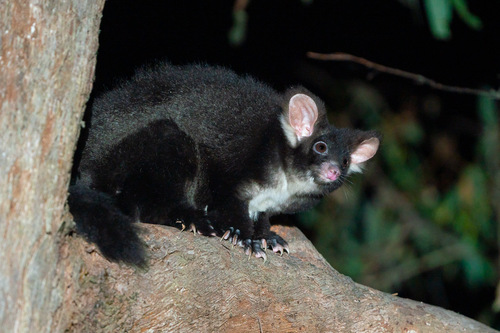
Greater Glider
Petauroides volans
Meet the 'flying teddy bear' of the Australian bush. With its oversized ears and incredibly long, bushy tail, the Greater Glider is the largest and most majestic of all gliding marsupials.
Quick Identification
Size
Head and body 35–46 cm (14–18 in), plus a long bushy tail of 45–60 cm (18–24 in); weight 1–1.7 kg (2.2–3.7 lbs)
Colors
Highly variable from sooty charcoal or dark grey to creamy white; usually has a pale cream or white underside; ears are fringed with dark fur
Key Features
- Oversized, furry, rounded ears
- Extremely long, bushy non-prehensile tail
- Gliding membrane extending from elbow to ankle
- Largest gliding marsupial in the world
When You’ll See Them
Geographic range
Where Does the Greater Glider Live?
Native to the continent of Australia, the Greater Glider is found along the eastern coastline and the Great Dividing Range. Its core range extends from the humid, high-rainfall forests of Queensland through New South Wales and into the cooler, high-altitude woodlands of Victoria. Within this region, it is restricted to pockets of mature forest that have remained relatively undisturbed by fire or logging.
Basemap © OpenStreetMap contributors
Behavior
The Greater Glider is a silent and solitary acrobat of the Australian canopy. Unlike its smaller, more social cousins like the Sugar Glider, this species is almost exclusively arboreal and rarely descends to the forest floor. It is a master of the air, capable of gliding up to 100 meters in a single flight, using its massive tail as a rudder to navigate through the dense network of branches. During the day, it retreats into large tree hollows to sleep, emerging after dusk to begin its nightly foraging.
These marsupials are surprisingly docile and slow-moving when not in flight, often spending hours in a single tree carefully selecting the best leaves to eat. Because they have a highly specialized diet and require old-growth trees for nesting, they are very sensitive to habitat changes. They are not known to interact much with humans, and because they don't vocalize loudly, they are often missed by casual observers despite their relatively large size.
EverydayEarth exclusive
Camera Tips
Capturing a Greater Glider on a trail camera requires thinking vertically. Since these animals almost never touch the ground, you must mount your camera high—ideally 3 to 6 meters up a tree trunk. Look for 'den trees,' which are large, old eucalypts with visible hollows. Aim your camera at a nearby 'launch branch' or the hollow entrance itself. Using a tree-climbing mount or a sturdy ladder is essential for this kind of placement.
Traditional food baits like peanut butter or oats will not work for Greater Gliders because they are strict leaf-eaters. Instead, focus on water sources during dry spells or simply rely on their habitual travel routes. They tend to use the same 'highway' of branches every night to move between their nesting hollow and their favorite feeding trees. Look for vertical scratch marks on smooth-barked gums as a sign of a frequently used tree.
Because they are strictly nocturnal, a camera with a high-quality infrared (IR) flash is mandatory. However, since Greater Gliders have very large, light-sensitive eyes, 'no-glow' or black LED IR is preferred to avoid startling them. Set your camera to video mode or high-speed burst; their glides are incredibly fast, and you’ll want to capture the motion of them spreading their membranes or steering with their massive tails.
Similar Species
Species that look similar or are commonly confused with Greater Glider.
Yellow-bellied Glider
Much more vocal with loud shrieks; has a distinct yellow/orange belly and smaller ears.
Sugar Glider
Significantly smaller (about 1/5th the size) with a dark stripe running down its forehead and back.
Squirrel Glider
Smaller than the Greater Glider with a more pointed face and lacks the huge, round, fluffy ears.
Frequently Asked Questions
Record Greater Glider at your habitat
Connect a camera to start building your own species record — AI identifies every visitor automatically.