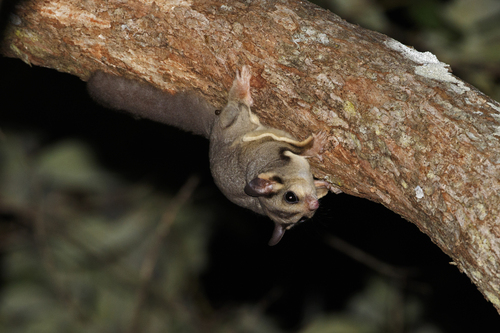
Mahogany Glider
Petaurus gracilis
The Mahogany Glider is one of Australia’s rarest treasures, a chestnut-colored aerialist found only in a tiny sliver of the tropical north. With a tail longer than its body and the ability to sail through the canopy, this endangered marsupial is a master of the night.
Quick Identification
Size
Head-body 23-28 cm (9-11 in), tail 34-41 cm (13-16 in); weight 310-450 g (11-16 oz)
Colors
Rich mahogany-brown to buff-grey upperparts, creamy-white to pale orange underbelly, with a distinct black dorsal stripe.
Key Features
- Long bushy tail significantly longer than the body
- Dark dorsal stripe running from the nose to the tail base
- Mahogany-tinted fur on the back and shoulders
- Large, dark, forward-facing eyes for night vision
When You’ll See Them
Geographic range
Where Does the Mahogany Glider Live?
Native to the Australian continent, the Mahogany Glider occupies one of the most restricted geographic ranges of any mammal in the country. It is found exclusively within a narrow 120-kilometre stretch of coastal lowland forest in North Queensland, spanning from the Hull River near Tully south to Ollera Creek. This rare species is a regional icon, surviving in fragmented patches of tropical woodland between the mountains and the Coral Sea.
Basemap © OpenStreetMap contributors
Behavior
The Mahogany Glider is a highly active nocturnal marsupial that spends its nights navigating the canopy of coastal Queensland. Unlike the more social Sugar Glider, Mahogany Gliders live in smaller family units, often consisting of a bonded pair and their recent offspring. They are masters of the air, using a specialized membrane called a patagium to glide up to 60 meters between trees, steering with their long, rudder-like tails.
These gliders are shy and rarely descend to the ground, as they are vulnerable to predators like feral cats and foxes. They communicate with a range of vocalizations, including a deep, nasal 'grnt' sound and more alarm-like shrieks. While they generally avoid human contact, they can be found in backyard gardens that border native sclerophyll forests, especially if those gardens contain their favorite flowering trees.
EverydayEarth exclusive
Camera Tips
To capture a Mahogany Glider on your AI camera, height is your most important factor. These animals rarely come close to the ground, so you should mount your camera at least 3 to 5 meters (10 to 16 feet) up a tree trunk. Aim the lens toward a nearby flowering Eucalyptus or Melaleuca branch, as these are natural magnets for the gliders when they feed on nectar and pollen.
Using a lure can significantly increase your chances. A common technique among wildlife researchers is to spray a mixture of honey and water onto the trunk directly in front of the camera. This mimics the sweet sap and nectar they crave. Ensure the camera is set to a fast trigger speed and burst mode, as their gliding arrivals and departures are incredibly quick and can be easily missed by slower sensors.
Settings should be optimized for low light. If your camera allows, set a high ISO or use an external infrared flash to illuminate the scene without startling the animals. Because they are active throughout the night, ensure your batteries are fully charged or use a solar panel attachment. Focus your efforts during the winter and spring months when many of their primary food trees are in peak flower, making the gliders more active and predictable in their foraging routes.
Similar Species
Species that look similar or are commonly confused with Mahogany Glider.
Sugar Glider
Much smaller in size with a greyish-blue coat rather than mahogany-brown.
Squirrel Glider
Predominantly grey fur and slightly smaller; lacks the rich chestnut tones of the Mahogany Glider.
Yellow-bellied Glider
Noticeably larger with a very distinct yellow or orange belly and much louder, shrieking vocalizations.
Frequently Asked Questions
Record Mahogany Glider at your habitat
Connect a camera to start building your own species record — AI identifies every visitor automatically.