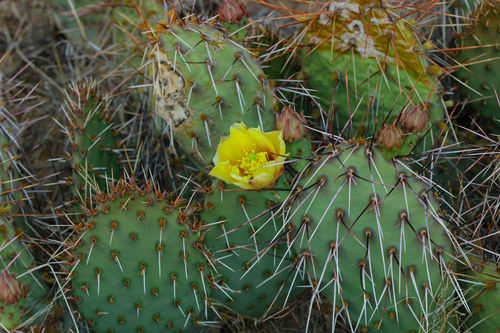
Brown-spined Pricklypear
Opuntia phaeacantha
A resilient desert architect, the Brown-spined Pricklypear provides vibrant spring blooms and essential sanctuary for backyard wildlife.
Quick Identification
Size
3-8 feet (0.9-2.4 m) wide, usually under 3 feet (0.9 m) tall; individual pads 4-7 inches (10-18 cm) long
Colors
Dull green to blue-green pads; spines are dark brown, reddish, or charcoal; yellow flowers often with red centers
Key Features
- Low-growing, spreading habit often forming dense mats
- Spines are primarily brown or dark-colored at the base
- Large yellow flowers with a bright orange or red 'eye' at the center
- Succulent pads that shrivel and wrinkle during winter or drought
When You’ll See Them
Geographic range
Where Does the Brown-spined Pricklypear Live?
Native to the North American continent, the Brown-spined Pricklypear is a signature species of the American Southwest and Northern Mexico. Its core range spans from the California deserts across Arizona and New Mexico into the Texas Panhandle and the lower Great Plains. It is frequently found in the Chihuahuan and Sonoran deserts and has been successfully introduced into arid-style gardens throughout temperate regions of the United States.
Basemap © OpenStreetMap contributors
Behavior
The Brown-spined Pricklypear is a hardy, spreading cactus that plays a vital role in desert and grassland ecosystems. Unlike upright tree-like cacti, this species tends to grow outward, forming thickets that provide essential cover for small mammals, reptiles, and ground-nesting birds. During the winter months or periods of extreme drought, the pads have a unique ability to lose water and shrivel, often turning a purple hue to protect themselves from freezing temperatures and intense sun.
In the spring, it produces a magnificent display of tulip-shaped flowers that open during the day and close at night. These blooms are a primary nectar source for native bees and cactus bees. Following the flowering season, the plant produces fleshy, spineless purple fruits known as 'tunas' which are a critical food source for desert wildlife. Its interaction with humans is primarily through xeriscaping, where it is valued for its low water needs and striking geometric form.
EverydayEarth exclusive
Camera Tips
When using an AI-powered camera to monitor a Brown-spined Pricklypear, think of the plant as a central 'hub' for wildlife activity. During the late spring blooming season (April to June), position your camera on a tripod or low mount just 2-3 feet away from a cluster of buds. Angle the lens slightly downward to capture the sequence of flowers opening. This is the best way to record high-quality footage of specialized cactus bees, hummingbirds, and butterflies that frequent the nectar-rich blooms during midday.
As the fruit (tunas) ripens in late summer and autumn, the plant becomes a magnet for larger visitors. Place your camera 5-10 feet back with a wide-angle view to catch Javelinas, Coyotes, and Desert Cottontails feeding on the purple fruits. Since these mammals often visit under the cover of darkness to avoid the heat, ensure your camera's infrared (IR) flash is active. Setting the trigger sensitivity to 'High' is recommended, as small rodents like Packrats often scurrying through the base of the cactus can be easily missed.
For the best aesthetic results, try to orient the camera so the sun is behind it or to the side during the 'golden hour' (late afternoon). The low sun angle will catch the long, brown spines and create a beautiful backlit effect against the blue-green pads. If your camera allows for time-lapse mode, a 30-second interval during a sunny morning is a fantastic way to capture the dramatic unfolding of the tulip-like flowers.
Similar Species
Species that look similar or are commonly confused with Brown-spined Pricklypear.
Frequently Asked Questions
Record Brown-spined Pricklypear at your habitat
Connect a camera to start building your own species record — AI identifies every visitor automatically.