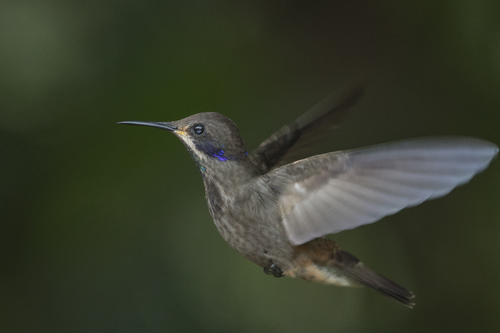
Brown Violetear
Colibri delphinae
A sophisticated dweller of the tropical highlands, the Brown Violetear swaps the typical bright greens of hummingbirds for an elegant, earthy palette accented by stunning violet 'ears'.
Quick Identification
Size
11.5–12 cm (4.5–4.7 in) in length; wingspan approx. 14 cm (5.5 in); weight 5.5–8 g (0.19–0.28 oz)
Colors
Mainly dull brown to grayish-brown with a scaly texture; metallic violet-blue patch on the ear-coverts and a glittering green throat; rufous-cinnamon rump.
Key Features
- Dull brownish-grey body plumage
- Brilliant violet-purple 'ear' patches
- Iridescent green throat (gorget)
- Slightly decurved medium-length black bill
- Rufous-edged tail with a dark band
When You’ll See Them
Geographic range
Where Does the Brown Violetear Live?
The Brown Violetear is native to the tropical highlands of Central and South America. Its range begins in southern Belize and Guatemala, stretching through the mountain chains of Costa Rica and Panama into the Andes of Colombia, Venezuela, and Ecuador. Isolated populations also inhabit the humid coastal mountains of eastern Brazil and the Caribbean island of Trinidad, making it a widespread resident of the Neotropical middle elevations.
Basemap © OpenStreetMap contributors
Behavior
The Brown Violetear is a bold and energetic hummingbird often found in the mid-story and canopy of forest edges. Unlike many of its more brightly colored relatives, it relies on its drab brown plumage for camouflage among branches, but it quickly reveals its identity through its loud, rhythmic 'chip' calls. It is known to be quite active and somewhat nomadic, moving locally to follow the blooming cycles of various trees and shrubs.
In a backyard or garden setting, this species displays a confident personality. While it is generally less aggressively territorial than the Green Violetear, it will still defend a choice nectar source from smaller hummingbirds. They are frequently observed perched on high, exposed twigs between feeding sessions, often returning to the same favorite 'sallying' branch after foraging for insects in mid-air.
EverydayEarth exclusive
Camera Tips
To successfully capture the Brown Violetear on your backyard camera, focus on elevation. This species prefers the canopy and mid-story levels rather than staying near the ground. Mount your camera at a height of 5 to 7 feet, ideally aimed at a high-quality hummingbird feeder or a cluster of native nectar plants like Porterweed (Stachytarpheta) or Heliconias. Angling the camera slightly upward can help capture the bird as it approaches from the treetops.
Lighting is the most critical factor for this species. Because their primary plumage is a subtle brown, they can look like simple silhouettes in poor light. Position your camera so that the sun is behind it, illuminating the bird's front. This is the only way to reliably trigger the iridescence of the violet ear patches and green throat on camera. Use a high shutter speed or 'sports mode' setting, as these birds move with incredible speed and agility.
If you are using an AI-powered camera, set up a 'perch'—a small, bare twig about 12-18 inches away from a feeder. Brown Violetears love to survey their surroundings before and after feeding. By focusing your camera on this perch, you are much more likely to get a clear, still shot of the bird's unique facial markings. During dry spells, adding a solar-powered water mister near the camera can also draw them in for spectacular bathing footage, which is a rare and rewarding sight.
Similar Species
Species that look similar or are commonly confused with Brown Violetear.
Frequently Asked Questions
Record Brown Violetear at your habitat
Connect a camera to start building your own species record — AI identifies every visitor automatically.