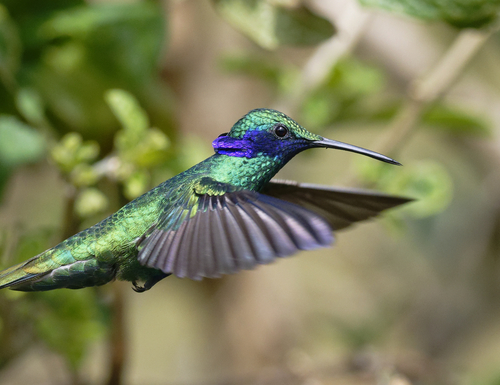
Sparkling Violetear
Colibri coruscans
A shimmering emerald icon of the Andes, the Sparkling Violetear is as bold in personality as it is in color. Famous for its vibrant violet ear patches and boisterous songs, this large hummingbird is the undisputed ruler of the high-altitude garden.
Quick Identification
Size
13-15 cm (5.1-5.9 in) long; wingspan 18-20 cm (7-8 in); weight 7-8.5 g (0.25-0.30 oz)
Colors
Metallic emerald green body with glittering violet-blue patches on the ears and throat; blue-green tail with a dark subterminal band; sexes are monomorphic (look similar).
Key Features
- Prominent iridescent violet-blue ear patches
- Large for a hummingbird with a slightly decurved black bill
- Centrally located blue patch on the breast and belly
- Constant, loud, metallic 'chip' vocalization
When You’ll See Them
Geographic range
Where Does the Sparkling Violetear Live?
The Sparkling Violetear is a signature inhabitant of the South American highlands, primarily following the massive curve of the Andes Mountains. Its native range spans from the northern mountains of Venezuela and Colombia, down through the heart of Ecuador and Peru, into Bolivia, and reaching its southern limits in northwestern Argentina and northern Chile. While it is most famous for its Andean presence, isolated populations also inhabit the unique, ancient flat-topped Tepui mountains within the Guiana Highlands of Venezuela, Guyana, and northern Brazil.
Basemap © OpenStreetMap contributors
Behavior
The Sparkling Violetear is renowned for its bold, assertive personality. Unlike many smaller hummingbirds that flit away at the sight of competition, this species is highly territorial and will aggressively defend its favorite nectar sources from other birds, often chasing away larger species. It is remarkably well-adapted to human presence, making it a frequent visitor to backyard feeders and urban parks in high-altitude cities like Quito and Bogotá.
Socially, these birds are solitary but highly vocal. Males spend a significant portion of their day perched on high, exposed branches, emitting a persistent, repetitive metallic chirping sound to advertise their territory. During courtship, they perform impressive aerial displays, diving and spiraling to showcase their iridescent plumage. Despite their aggression toward rivals, they are fascinating to watch as they exhibit high levels of intelligence and memory regarding flower blooming cycles.
EverydayEarth exclusive
Camera Tips
To capture the stunning iridescence of a Sparkling Violetear, camera placement is everything. Position your AI-powered camera within 3 to 5 feet of a nectar feeder or a cluster of tubular red flowers like Salvias or Fuchsias. Because these birds are larger and slower-moving than some tiny hummers, they provide a great subject, but you still need a fast shutter speed—ideally 1/2000s or higher—to freeze the wing motion. If your camera allows for manual focus, pre-focus on a specific feeder port or a prominent flower to ensure the bird’s eye is sharp when it enters the frame.
Lighting is the 'secret sauce' for this species. Their violet ear patches only 'sparkle' when the light hits them at a specific angle. Try to position your camera with the sun at your back, illuminating the bird from the front. The golden hours of early morning and late afternoon provide the best directional light to make those metallic feathers pop. If you are using a trail camera, look for a 'singing perch'—a high, bare twig where the bird repeatedly returns to chirp. This is often the best spot for a clear, unobstructed shot.
Don't overlook the audio capabilities of your camera. Sparkling Violetears are incredibly vocal; their repetitive, metallic 'tcheep-tcheep' is a staple of Andean soundscapes. If your camera has a high-quality microphone, you can capture their territorial calls, which are just as much a part of their identity as their colors. In the rainy season, these birds remain active, so ensuring your camera has a rain guard or a small overhang will allow you to capture unique footage of them bathing or shaking off water droplets.
Similar Species
Species that look similar or are commonly confused with Sparkling Violetear.
Frequently Asked Questions
Record Sparkling Violetear at your habitat
Connect a camera to start building your own species record — AI identifies every visitor automatically.