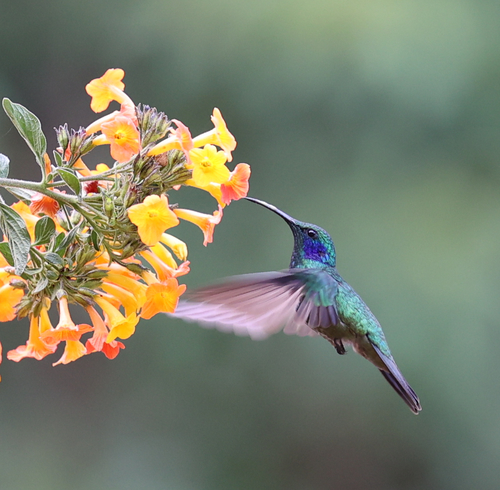
Lesser Violetear
Colibri cyanotus
A shimmering jewel of the high-altitude cloud forests, the Lesser Violetear is as famous for its aggressive personality as it is for its brilliant metallic green and violet plumage.
Quick Identification
Size
10-12 cm (3.9-4.7 in) in length; weight of 4.8-5.6 g (0.17-0.20 oz)
Colors
Shimmering emerald green body; distinctive violet-blue patches on the sides of the head; blue-green tail with a dark band.
Key Features
- Brilliant violet-blue 'ear' tufts
- Metallic green iridescent plumage
- Slightly decurved black bill
- Notched tail with a dark subterminal band
When You’ll See Them
Geographic range
Where Does the Lesser Violetear Live?
Native to the mountainous regions of Central and South America, the Lesser Violetear is a true highland specialist. Its core range begins in the lush cloud forests of Costa Rica and Panama, extending southward along the Andean corridor through Colombia, Venezuela, Ecuador, and Peru, reaching as far as Bolivia and northern Argentina. While they are primarily mountain dwellers, they are adaptable enough to frequent high-altitude suburban areas where flowering gardens are present.
Basemap © OpenStreetMap contributors
Behavior
The Lesser Violetear is a high-energy hummingbird known for its bold and highly territorial personality. It is often the dominant bird at feeding stations, aggressively chasing away other hummingbirds and even larger avian species to protect its nectar sources. Its vocalizations are persistent, consisting of a sharp, metallic 't'sip' or 'chit' sound repeated throughout the day, which it uses to signal its presence and territory.
In social settings, these hummingbirds are solitary except during mating. They exhibit a foraging strategy known as 'traplining,' where they visit a specific circuit of flowers in a predictable order, though they will readily abandon this for a high-quality food source like a backyard feeder. Their flight is exceptionally agile, capable of hovering and flying backward with precision.
EverydayEarth exclusive
Camera Tips
To capture the Lesser Violetear on camera, the most effective strategy is to place your device near a hummingbird feeder or a cluster of red and tubular flowers like Salvia or Fuchsia. Because these birds are territorial, they often return to the same perch between feedings to survey their domain. Identifying this 'guard perch'—usually a bare twig with a clear line of sight to the feeder—is the secret to getting high-quality, still shots of an otherwise fast-moving bird.
Set your camera to a high shutter speed or 'action' mode to freeze the motion of their wings, which can beat up to 50-80 times per second. Positioning is key: aim for a north-facing angle to avoid harsh shadows and ensure the sun highlights the iridescent green and violet feathers. Avoid placing the camera too low; these birds prefer feeders at least 4-5 feet off the ground where they feel safer from terrestrial predators.
For AI-powered cameras, use a high sensitivity trigger setting. These birds are small and move with incredible speed, so a low-latency trigger is essential. If your camera allows for burst photos, set it to take 3-5 shots per trigger event to ensure you catch the perfect wing position. Since they are most active in the early morning, ensure your camera has a clear view as the first light hits your garden.
Similar Species
Species that look similar or are commonly confused with Lesser Violetear.
Mexican Violetear
Almost identical but found further north in Mexico; has slightly different vocalizations.
Sparkling Violetear
Larger than the Lesser Violetear and features a distinct blue patch on the center of the breast and belly.
Brown Violetear
Easily distinguished by its dull brown plumage instead of metallic green.
Frequently Asked Questions
Record Lesser Violetear at your habitat
Connect a camera to start building your own species record — AI identifies every visitor automatically.