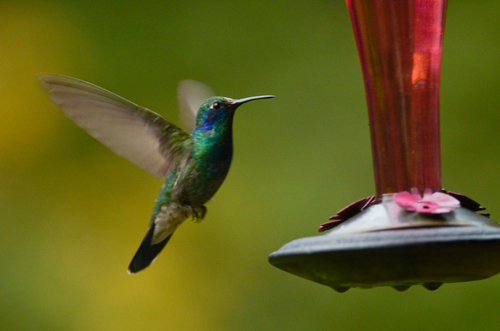
Mexican Violetear
Colibri thalassinus
A shimmering emerald jewel of the highlands, the Mexican Violetear is as bold as it is beautiful, known for its striking violet ear patches and fearless attitude at garden feeders.
Quick Identification
Size
10.5–12 cm (4.1–4.7 in) length; 15 cm (6 in) wingspan; 5–6 g (0.18–0.21 oz) weight
Colors
Brilliant metallic emerald green body; glittering violet-blue patches on sides of head; blue-green patch on center of chest
Key Features
- Distinctive violet-blue 'ear' patches on the side of the head
- Iridescent emerald green plumage with a blue-tinted breast
- Broad, notched tail with a dark subterminal band
- Black, slightly decurved bill
When You’ll See Them
Geographic range
Where Does the Mexican Violetear Live?
Native to the highlands of North and Central America, the Mexican Violetear's core territory stretches from the mountains of Mexico through Guatemala, El Salvador, and Honduras to northern Nicaragua. While they are primarily residents of these tropical and subtropical latitudes, they are famous for their wandering nature, frequently appearing as vagrants in the United States and occasionally as far north as Canada. This species thrives in the 'eternal spring' of mid-to-high altitude cloud forests and oak groves.
Basemap © OpenStreetMap contributors
Behavior
The Mexican Violetear is a high-energy, territorial hummingbird that dominates the airspace of its mountain home. Unlike many smaller hummingbirds that may flee from confrontation, this species is notoriously aggressive, often chasing away larger birds and even other hummingbirds from its preferred nectar sources. They are vocal creatures, frequently seen perched on high, exposed branches where males emit a repetitive, metallic, and rhythmic 'chiping' song to claim their territory.
These birds are known for their altitudinal migration, moving down to lower elevations during the colder months or following the blooming cycles of various wildflowers. While they are primarily solitary, they may gather in loose groups at productive feeding sites. Their flight is swift and direct, and they have a curious habit of hovering with their tail slightly cocked and fanned, showing off the dark band at the tip.
EverydayEarth exclusive
Camera Tips
To capture the stunning iridescence of the Mexican Violetear, position your AI-powered camera within three to five feet of a sugar-water feeder or a cluster of tubular red or purple flowers like Salvia, Penstemon, or Fuchsia. Since these birds move with incredible speed, ensure your camera is set to its highest shutter speed or a dedicated 'Bird' mode to freeze the wing motion. Direct overhead sunlight can sometimes wash out their colors, so try to place your setup in an area with bright but diffused light to truly highlight the metallic green and violet patches.
Height is a critical factor for this species; they prefer to feed and perch between four and eight feet off the ground. Aim your camera slightly upward if possible to catch the light reflecting off the iridescent gorget and ear patches. Because the Mexican Violetear is highly territorial, once a bird identifies your yard as its territory, it will return to the same perches repeatedly. Look for a nearby bare twig or wire where the bird sits between feedings and aim a camera there for high-quality, still portraits.
If you are using an AI trigger, ensure the sensitivity is high enough to detect small, fast-moving objects. These birds are most active in the early morning shortly after sunrise and again in the late afternoon. During these times, the 'golden hour' light provides a spectacular glow that makes their feathers shimmer. In the summer, keeping the nectar fresh (changing it every 2-3 days) is vital, as these high-metabolism birds will check feeders multiple times an hour and are more likely to linger if the food source is consistent and clean.
Similar Species
Species that look similar or are commonly confused with Mexican Violetear.
Lesser Violetear
Almost identical but found in South America; it is slightly smaller and lacks the bright blue-green chest patch of the Mexican species.
Rivoli's Hummingbird
Much larger with a distinct purple crown and emerald throat, lacking the violet patches on the sides of the head.
Broad-billed Hummingbird
Has a bright red bill with a black tip and a blue throat, but lacks the violet 'ear' patches.
Frequently Asked Questions
Record Mexican Violetear at your habitat
Connect a camera to start building your own species record — AI identifies every visitor automatically.