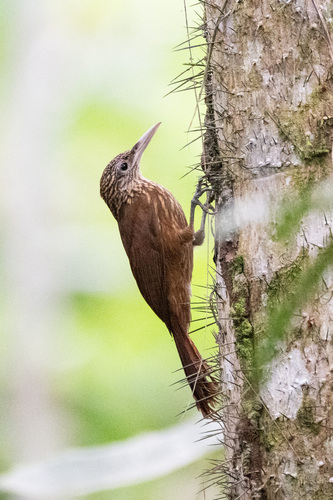
Buff-throated Woodcreeper
Xiphorhynchus guttatus
Masters of the vertical ascent, Buff-throated Woodcreepers are the forest's restless climbers, spiraling up trunks in a never-ending search for hidden prey.
Quick Identification
Size
Length: 22.5–29.5 cm (8.8–11.6 in); Wingspan: 35–41 cm (13.8–16.1 in); Weight: 45–75 g (1.6–2.6 oz)
Colors
Rich olive-brown body with rufous-colored wings and tail; distinct buffy-cream throat and heavy pale streaking on the head and breast; dark, slightly decurved bill.
Key Features
- Distinctive buff or cream-colored throat without markings
- Stiff, spiny-tipped tail feathers used for support on trunks
- Heavy, slightly curved bill with a pale lower mandible
- Rhythmic 'hitching' movement up tree trunks
When You’ll See Them
Geographic range
Where Does the Buff-throated Woodcreeper Live?
The Buff-throated Woodcreeper is a native resident of the tropical South American continent, primarily centered within the massive Amazon Basin. Its range extends across northern and central South America, including the core countries of Brazil, Peru, Colombia, and Venezuela, as well as the Guyanas (Guyana, Suriname, and French Guiana). It is also found in the lowland forests of eastern Ecuador and northern Bolivia, maintaining a consistent presence in humid, wooded environments throughout these regions.
Basemap © OpenStreetMap contributors
Behavior
The Buff-throated Woodcreeper is a specialist of the vertical environment, spending its day spiraling up the trunks of large trees. It uses its stiff, woodpecker-like tail feathers to brace itself against the bark while it probes crevices for hidden prey. Once it reaches the mid-canopy or higher, it typically glides down to the base of a neighboring tree to begin its ascent again. Unlike many birds, they rarely perch on horizontal branches, preferring the upright world of the trunk.
These birds are well-known participants in mixed-species foraging flocks, where they often act as a central figure, moving through the forest alongside tanagers and other woodcreepers. They are also opportunistic 'ant-followers.' While they don't eat the ants themselves, they stay close to army ant swarms to snatch up the grasshoppers, spiders, and small lizards that are flushed out by the advancing insects. While generally shy, they can become habituated to human presence in forest edges and shady plantations.
EverydayEarth exclusive
Camera Tips
To successfully capture a Buff-throated Woodcreeper on a backyard or trail camera, you must think vertically. These birds rarely land on the ground or horizontal perches. Mount your camera on the trunk of a large, mature tree—ideally one with rough, furrowed bark—aiming across to another nearby trunk. Set the camera at a height of 4 to 6 feet, which is the typical 'landing zone' for these birds as they begin their upward climb. A slight upward angle is often more effective than a level mount.
Since they do not visit seed or suet feeders, you should look for natural attractants. If you have a property with army ant activity, placing the camera on a trunk within 10 feet of the swarm is a surefire way to catch them in action. Additionally, they are drawn to water in hot climates. A birdbath placed near the base of a large tree can entice them to come down, though they will often prefer to cling to the side of the basin or an adjacent trunk rather than landing on a rim.
Because woodcreepers move with a series of quick, jerky 'hitches,' use a high-speed trigger setting to avoid blurry images. If your camera supports video, use a 60fps setting to capture the unique way they use their tail for support. They are most active in the early morning when the forest is waking up, so ensure your camera is positioned to handle the low-light conditions of a shaded canopy. Avoid areas with heavy leaf litter in the immediate foreground, as the wind-blown leaves can trigger the PIR sensor unnecessarily in the dense understory where these birds live.
Similar Species
Species that look similar or are commonly confused with Buff-throated Woodcreeper.
Frequently Asked Questions
Record Buff-throated Woodcreeper at your habitat
Connect a camera to start building your own species record — AI identifies every visitor automatically.