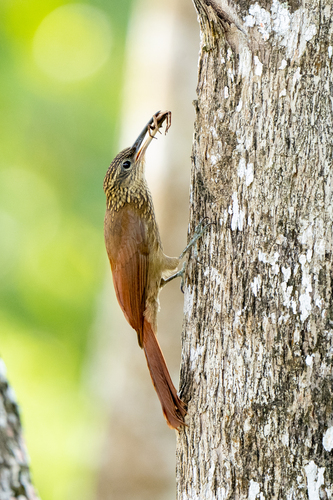
Cocoa Woodcreeper
Xiphorhynchus susurrans
A master of the vertical climb, the Cocoa Woodcreeper is a vocal resident of Neotropical forests and gardens. With its stiff-tailed hitching movement and rich, streaked plumage, it is one of the most charismatic insect-hunters of the tropical shade.
Quick Identification
Size
22–25 cm (8.7–9.8 in) long; weighs between 37–54 g (1.3–1.9 oz)
Colors
Rich cocoa-brown body with prominent buffy-white streaks on the head, neck, and breast; wings and tail are a warm rufous-cinnamon; bill is blackish with a pale base.
Key Features
- Large, slightly decurved bill with a pale lower mandible
- Heavy buff-colored streaking on the chest and head
- Stiff, pointed tail feathers used for trunk propping
- Spiraling climbing movement up tree trunks
When You’ll See Them
Geographic range
Where Does the Cocoa Woodcreeper Live?
The Cocoa Woodcreeper is a native of the Neotropics, primarily spanning Central America and northern South America. Its core range extends from eastern Guatemala and Honduras through Nicaragua, Costa Rica, and Panama, reaching into the northern lowlands of Colombia and Venezuela. It is also a very common resident on the islands of Trinidad and Tobago, where it is one of the most frequently seen woodcreepers in both wild and semi-urban settings.
Basemap © OpenStreetMap contributors
Behavior
The Cocoa Woodcreeper is a quintessential 'trunk-creeper,' moving in a distinctive spiral pattern as it hitches its way up tree trunks. Using its stiff tail feathers as a tripod for stability, it probes deep into bark crevices and bromeliads searching for hidden prey. It is a bold, conspicuous bird, often making its presence known with a series of loud, musical whistled notes that descend in pitch.
These birds are highly opportunistic and are famous for following army ant swarms. They don't eat the ants themselves but instead perch just above the moving column to snatch up grasshoppers, spiders, and beetles that are trying to escape the ants. While they are generally solitary or found in pairs, they frequently join mixed-species foraging flocks, acting as a watchful sentry for other birds in the understory.
EverydayEarth exclusive
Camera Tips
To capture high-quality footage of a Cocoa Woodcreeper, your camera placement should focus on the 'vertical highway.' Mount your AI-powered camera on the trunk of a large, rough-barked tree about 5 to 7 feet off the ground. Instead of pointing it straight across, angle it slightly upward. This captures the bird as it spirals up the trunk toward the lens, providing a clear view of the identifying streaks on its breast and its specialized bill.
While woodcreepers won't visit standard bird feeders, they are intensely attracted to water features in hot climates. A birdbath with a shallow 'dripper' or a small fountain is an excellent lure. Position your camera to overlook the edge of the water source, as woodcreepers often pause on the vertical trunk of a nearby tree before hopping down for a quick drink or bath.
Because these birds thrive in the shaded understory, lighting can be a challenge. If possible, place your camera in an area that receives dappled morning light. Set your camera to a high trigger speed or burst mode; woodcreepers move in quick, jerky hitches and often only pause for a second to grab an insect. A camera with a fast recovery time will ensure you don't miss the moment they strike at a hidden beetle.
Similar Species
Species that look similar or are commonly confused with Cocoa Woodcreeper.
Frequently Asked Questions
Record Cocoa Woodcreeper at your habitat
Connect a camera to start building your own species record — AI identifies every visitor automatically.