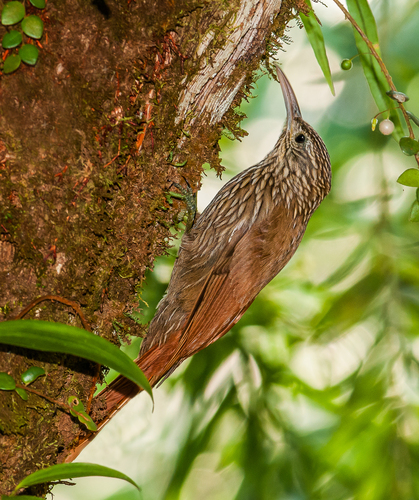
Streak-headed Woodcreeper
Lepidocolaptes souleyetii
A master of camouflage and vertical movement, the Streak-headed Woodcreeper is a frequent visitor to forest edges and garden clearings. Watch for its slender, curved bill as it hitches up tree trunks in search of hidden insects.
Quick Identification
Size
19-21 cm (7.5-8.2 in) long; 25-32 g (0.9-1.1 oz)
Colors
Olive-brown body with prominent buffy-white streaks on the head, neck, and breast; wings and tail are a warm cinnamon-rufous.
Key Features
- Slender, pale, slightly decurved bill
- Heavy buffy-white streaks on the crown, nape, and mantle
- Stiff, spiny tail feathers used for propping against bark
- Underparts feature long, horizontal pale streaks
When You’ll See Them
Geographic range
Where Does the Streak-headed Woodcreeper Live?
The Streak-headed Woodcreeper is a quintessential Neotropical species, making its home across a vast expanse of the Americas. Its native territory begins in the coastal lowlands of southern Mexico and extends through every country in Central America, eventually reaching deep into the northern half of South America. Within its core range, it is a common sight from the Pacific slopes of Ecuador and Peru to the Atlantic coasts of Venezuela, Guyana, and northern Brazil, including the island of Trinidad.
Basemap © OpenStreetMap contributors
Behavior
The Streak-headed Woodcreeper is a master of vertical movement, spending its day 'hitching' up tree trunks in a spiral fashion. Using its stiff, specialized tail feathers as a brace, it probes into bark crevices with its long bill to extract hidden insects. Unlike many of its deeper-forest relatives, this species is relatively bold and well-adapted to human-altered landscapes, often seen in open clearings and garden edges.
While they are frequently seen alone or in pairs, they are social enough to join mixed-species foraging flocks, following tanagers and flycatchers through the canopy. They are highly vocal, often giving away their presence with a rapid, descending trill or a series of sharp 'wick' calls. They are non-migratory and maintain territories year-round, which they defend with persistent vocalizations during the breeding season.
EverydayEarth exclusive
Camera Tips
Capturing the Streak-headed Woodcreeper on an AI-powered camera requires a different strategy than your average songbird. Because these birds spend their lives hitching vertically up tree trunks, placing your camera on a standard bird feeder won't yield many results. Instead, mount your camera roughly 4 to 6 feet high on the trunk of a large, rough-barked tree, angled slightly toward a neighboring tree or a main branch junction. This 'trunk-to-trunk' view captures them as they spiral upward in search of prey.
While they won't visit seed or suet feeders, they are frequently drawn to water. A pedestal bird bath or a fountain located near the edge of a wooded area can provide excellent footage, especially during the dry season. Ensure your camera is set to a high trigger speed or 'video mode,' as their movements can be jerky and fast as they probe bark crevices with their long, decurved bills. This allows the AI to capture the full motion of their unique foraging behavior.
Morning is prime time for this species, specifically the first three hours after sunrise when they are most vocal and active in mixed-species foraging flocks. To get the clearest shots, try to position your camera so it is back-lit by the morning sun, which will highlight the intricate buffy streaking on their head and breast—the key diagnostic feature for distinguishing them from other woodcreeper species. Avoid placing cameras in deep, dark forest interiors; focus on the sun-dappled 'edges' where this species prefers to hunt.
Similar Species
Species that look similar or are commonly confused with Streak-headed Woodcreeper.
Frequently Asked Questions
Record Streak-headed Woodcreeper at your habitat
Connect a camera to start building your own species record — AI identifies every visitor automatically.