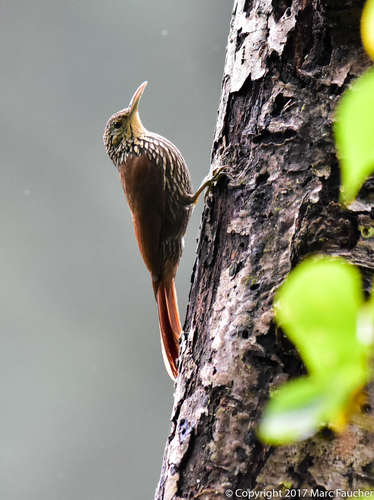
Spot-crowned Woodcreeper
Lepidocolaptes affinis
A master of the vertical climb, the Spot-crowned Woodcreeper is the high-altitude specialist of the Middle American cloud forests. Watch for its unique 'hitch-and-glide' technique as it spirals up moss-covered trunks in search of hidden prey.
Quick Identification
Size
Length: 19-22 cm (7.5-8.5 in); Weight: 30-38 g (1.1-1.3 oz)
Colors
Rich olive-brown upperparts with cinnamon wings and tail; head and underparts feature heavy buff-white streaking, with distinct small buff spots on the crown.
Key Features
- Fine buff-colored spots on the crown
- Slender, pale-colored, slightly decurved bill
- Stiff, pointed tail feathers for vertical support
- Deeply streaked buff and brown underparts
When You’ll See Them
Geographic range
Where Does the Spot-crowned Woodcreeper Live?
Native to the high-altitude forests of Middle America, the Spot-crowned Woodcreeper is a signature species of the montane regions stretching from central Mexico down through the highlands of Central America to western Panama. It is most commonly found in the misty cloud forests and pine-oak woodlands of the Sierra Madre and the Talamanca mountain ranges. This bird is a permanent resident throughout its range, occupying stable territories in the interior forests of Costa Rica, Guatemala, and Mexico.
Basemap © OpenStreetMap contributors
Behavior
The Spot-crowned Woodcreeper is a specialist of the vertical world, spending nearly its entire life spiraling up tree trunks in a methodical search for food. Unlike woodpeckers that drill into wood, this species uses its delicate, slightly curved bill to probe into moss, bromeliads, and bark crevices. It moves with a rhythmic 'hitch-and-glide' pattern—climbing a trunk in a spiral before flying down to the base of a nearby tree to start the climb again.
These birds are core members of mixed-species foraging flocks in the highlands, often moving alongside warblers and bush-tanagers. While they are generally solitary or seen in pairs, they are quite vocal, making their presence known with a thin, descending series of whistles. They are relatively tolerant of human presence as long as their high-altitude forest habitat remains intact, though they rarely descend to the ground.
EverydayEarth exclusive
Camera Tips
Capturing the Spot-crowned Woodcreeper requires a 'trunk-mount' strategy rather than a traditional feeder setup. Because these birds spend their time vertically attached to bark, secure your AI camera directly to a large, textured tree trunk—ideally one covered in moss or lichens—at a height of 4 to 6 feet. Angle the lens slightly upward (about 10-15 degrees) to catch the bird as it hitches its way up from the base toward the canopy.
Focus is the biggest challenge with woodcreepers. Since they stay very close to the bark, set your camera to a close-range focal distance (3-5 feet) if your model allows it. These birds move in quick, jerky bursts, so use a high-speed trigger or a video mode with a high frame rate to avoid motion blur. If your camera is triggered by AI, ensure it is set to recognize 'Birds' specifically to catch the fast-moving spiraling action.
Timing is everything for this high-altitude resident. They are most active in the early morning before the afternoon mountain mists roll in. If you live in their range, you can increase your chances by leaving dead wood and native epiphytes on your trees. A camera placed near a high-elevation water feature or a dripping mossy log during the dry season can also result in unique footage, as they will occasionally visit for a quick drink or bath.
Similar Species
Species that look similar or are commonly confused with Spot-crowned Woodcreeper.
Frequently Asked Questions
Record Spot-crowned Woodcreeper at your habitat
Connect a camera to start building your own species record — AI identifies every visitor automatically.