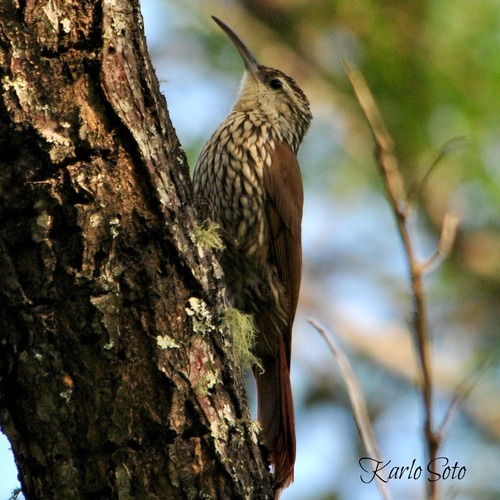
White-striped Woodcreeper
Lepidocolaptes leucogaster
An architectural marvel of the Mexican highlands, the White-striped Woodcreeper is famous for its bold 'teardrop' markings and its ability to spiral up tree trunks with gravity-defying ease.
Quick Identification
Size
21 to 23.5 cm (8.3 to 9.25 in) long; weight approximately 30 to 40 g (1.1 to 1.4 oz)
Colors
Rufous-brown back and wings, grayish-brown head with white streaks, prominent white eyebrow, and bold white teardrop streaks on the underparts
Key Features
- Long, decurved horn-colored bill
- Bold white teardrop-shaped streaks on breast and belly
- Broad white eyebrow line (supercilium)
- Stiff, spiny tail feathers for trunk support
When You’ll See Them
Geographic range
Where Does the White-striped Woodcreeper Live?
Native to North America, the White-striped Woodcreeper is a unique endemic species found exclusively within the borders of Mexico. Its core range stretches along the Pacific slope from Sonora and Chihuahua down through the interior mountains to Oaxaca, as well as sections of the Sierra Madre Oriental. It thrives in the temperate and subtropical highland forests, rarely venturing beyond these rugged Mexican landscapes.
Basemap © OpenStreetMap contributors
Behavior
The White-striped Woodcreeper is a master of the vertical world, spending the majority of its life hitching up the trunks of mature trees. It moves in a characteristic spiral fashion, using its stiff, specialized tail feathers as a tripod-like prop against the bark while it probes for food. Once it reaches the mid-to-high canopy, it typically flies down to the base of a nearby tree to begin the ascent again.
Generally solitary or seen in pairs, this species is known for its relatively bold nature compared to other woodcreepers. It is a frequent member of mixed-species foraging flocks, often moving alongside warblers and vireos. While it isn't a bird that interacts directly with humans, it is quite tolerant of activity nearby as long as its forest habitat remains intact.
EverydayEarth exclusive
Camera Tips
To capture the White-striped Woodcreeper on camera, skip the traditional bird feeder and focus on the architecture of your trees. Place your camera at eye-level or slightly higher (5-8 feet) pointed directly at the vertical trunk of a mature oak or pine. Because these birds spend their time 'hitching' up bark, a camera aimed at a clear section of a large, textured trunk is your best bet for a clear shot.
Speed is essential when photographing woodcreepers. They move in quick, jerky bursts and often spiral around the tree, meaning they may only be in your camera's field of view for a few seconds. Set your trigger speed to the fastest possible setting and use a burst mode or 'photo plus video' setting. This ensures you catch the bird while it is stationary and probing into the bark, rather than just a blurry tail as it moves out of frame.
While they don't visit seed trays, woodcreepers are attracted to water, especially in drier highland seasons. Position a camera overlooking an elevated birdbath or a natural hollow in a log that holds water. If you can add a small 'dripper' or recirculating pump, the sound of moving water is a powerful magnet for this species and may bring them down from the canopy to a height where your camera can get a stunning close-up.
Lighting can be tricky in dense forests. Try to mount your camera on a tree that receives dappled sunlight during the morning hours. The white 'teardrop' markings on the bird's breast are highly reflective and can blow out in direct, harsh midday sun, so early morning or late afternoon light will provide the best contrast and detail for your photos.
Similar Species
Species that look similar or are commonly confused with White-striped Woodcreeper.
Frequently Asked Questions
Record White-striped Woodcreeper at your habitat
Connect a camera to start building your own species record — AI identifies every visitor automatically.