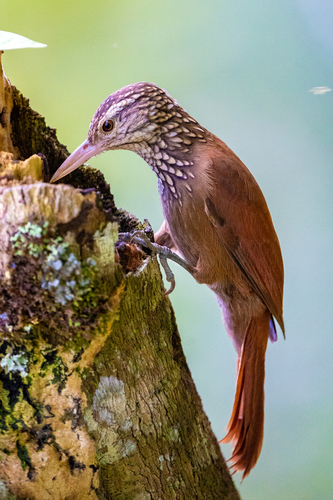
Straight-billed Woodcreeper
Dendroplex picus
A master of the vertical climb, the Straight-billed Woodcreeper is an adaptable insect-hunter found from coastal mangroves to suburban backyards. Its ivory-colored, chisel-like bill and specialized tail make it one of the most efficient bark-probers in the neotropics.
Quick Identification
Size
Length of 18–22.5 cm (7–9 in); weighs approximately 33–48 g (1.1–1.7 oz)
Colors
Rich rufous-brown wings and tail, olive-brown back, with distinct buff-white streaking on the head, neck, and breast. The heavy, straight bill is typically pale ivory to horn-colored.
Key Features
- Distinctly straight, pale ivory-colored bill
- Bold buffy-white teardrop streaks on the breast and crown
- Stiff-tipped tail feathers used for bracing against tree trunks
- Rufous-colored wings and tail contrasting with a browner back
When You’ll See Them
Geographic range
Where Does the Straight-billed Woodcreeper Live?
Native to Central and South America, the Straight-billed Woodcreeper thrives across a massive geographic area. Its territory begins in central Panama and extends through Trinidad and Tobago, reaching across the northern half of South America into the Amazon basin and down through Brazil. While it is a common sight in countries like Colombia, Venezuela, and Peru, it is notably absent from the southern cone countries of Chile, Argentina, Paraguay, and Uruguay.
Basemap © OpenStreetMap contributors
Behavior
The Straight-billed Woodcreeper is a quintessential trunk-climbing specialist. It behaves much like a woodpecker, using its stiff, specialized tail feathers as a tripod to prop itself against bark while it hitches upward in a spiral pattern. It is a solitary forager or found in pairs, often moving from the base of one tree to the mid-canopy before flying down to the base of the next tree to repeat the process.
While many woodcreepers are shy forest-dwellers, this species is notably adaptable and relatively bold around human habitation. It is frequently seen in suburban gardens, parks, and at the edges of clearings. It is not a social bird by nature but will occasionally join mixed-species foraging flocks when they pass through its territory, though it rarely follows them for long.
EverydayEarth exclusive
Camera Tips
To capture high-quality footage of a Straight-billed Woodcreeper, camera placement is everything. These birds are vertical specialists, so avoid pointing your camera at the ground. Instead, mount your AI camera directly onto the trunk of a large, rough-barked tree at a height of 1.5 to 2 meters (5 to 7 feet). Trees with deeply furrowed bark or those host to bromeliads and vines are prime real estate for their foraging trips.
Angle the camera slightly upward. Because woodcreepers hitch their way up a tree and then fly down to the base of the next one, they usually appear at the bottom of your frame and move toward the top. Setting your camera to a wide-angle view will help you track their spiraling movement as they circle the trunk. Since they move in quick, jerky hops, a fast trigger speed and a high frame rate (at least 30fps) are necessary to prevent motion blur.
In a backyard setting, you won't attract them with birdseed, but you can entice them by preserving 'wild' vertical spaces. Avoid using pesticides, as these birds rely on a healthy population of bark-dwelling insects. If your camera has a 'time-lapse' or 'photo-burst' mode, use it during the early morning hours when the sun is at a low angle; the side-lighting will highlight the bird's buffy breast streaks and the texture of the bark, making for a much more dramatic image.
Similar Species
Species that look similar or are commonly confused with Straight-billed Woodcreeper.
Frequently Asked Questions
Record Straight-billed Woodcreeper at your habitat
Connect a camera to start building your own species record — AI identifies every visitor automatically.