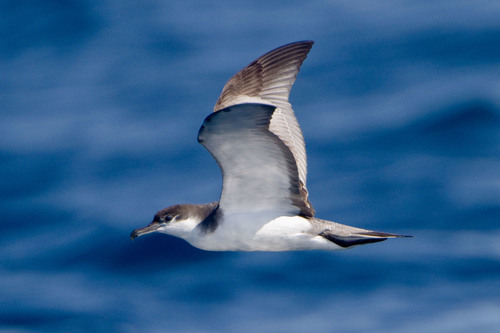
Buller's Shearwater
Ardenna bulleri
A champion of the Pacific, the Buller's Shearwater is famous for its striking 'M' wing pattern and a migration that spans the entire globe. Breeding only on a single chain of New Zealand islands, this elegant flyer is a prized sight for coastal birdwatchers.
Quick Identification
Size
Length: 46–47 cm (18–19 in); Wingspan: 97–102 cm (38–40 in); Weight: 340–425 g (12–15 oz)
Colors
Pale grey upperparts with a dark 'M' pattern across the wings; snow-white underparts and throat; dark grey cap; bluish-grey bill with a dark tip.
Key Features
- Bold dark 'M' marking across pale grey wings and back
- Contrasting dark cap and white cheeks
- Long, slender bluish-grey bill
- Wedge-shaped tail and long, narrow wings
When You’ll See Them
Geographic range
Where Does the Buller's Shearwater Live?
Native to the Pacific Ocean, Buller's Shearwater has a remarkably specific breeding home, nesting only on the Poor Knights Islands off the northeastern coast of New Zealand. From these volcanic cliffs, the species embarks on a massive annual journey, migrating across the equator to spend the austral winter in the North Pacific. During this time, they are commonly spotted along the Pacific Coast of the United States and Canada, as well as near the coasts of Japan and Russia, making them one of the most widely traveled seabirds in the world.
Basemap © OpenStreetMap contributors
Behavior
Buller's Shearwaters are masters of the air, known for their exceptionally graceful and buoyant flight. Unlike some of their heavier relatives, they glide effortlessly over the ocean swells with deep, slow wingbeats. They are highly social at sea, often gathering in massive 'rafts' numbering in the thousands. These birds are frequently seen following schools of tuna or other predatory fish, which drive smaller prey to the surface where the shearwaters can easily snatch them up.
While they are mostly silent at sea, they become incredibly vocal at their breeding colonies, emitting a series of cackles, howls, and groans. To avoid predators like gulls and hawks, they are strictly nocturnal when visiting their nesting burrows. During the non-breeding season, they undertake an incredible trans-equatorial migration, traveling in a giant figure-eight pattern across the Pacific Ocean to reach the rich feeding grounds of the North Pacific.
EverydayEarth exclusive
Camera Tips
Capturing a Buller's Shearwater on camera is a unique challenge because they spend almost their entire lives at sea. If you live on a coastal property with a view of the Pacific, the best approach is to mount your camera on a high-stability tripod facing the ocean. Use a telephoto lens or a camera with a significant optical zoom. Since these birds move quickly against the horizon, set your camera to a fast shutter speed (at least 1/2000s) to freeze the motion of their distinctive 'M' wing pattern.
For those using AI-powered cameras on boats or near coastal cliffs, 'Interval Mode' is often more effective than motion triggering. Motion sensors frequently struggle with the distance and the constant movement of waves, leading to false triggers or missed shots. Set your camera to take a burst of photos every 1-5 minutes during peak foraging hours (early morning and late afternoon) when the birds are most likely to be active near the shore.
If you are lucky enough to be near a breeding site or a known 'rafting' area, use a camera with high-quality low-light or infrared capabilities. At the breeding colonies, Buller's Shearwaters only arrive under the cover of darkness. Position your camera near burrow entrances (without disturbing the nest!) at a low angle to capture their clumsy but fascinating ground movements. Ensure your gear is rated for high salt-spray environments, as the coastal air will quickly corrode standard electronics; using a protective silicone housing or a dedicated marine enclosure is highly recommended.
Similar Species
Species that look similar or are commonly confused with Buller's Shearwater.
Frequently Asked Questions
Record Buller's Shearwater at your habitat
Connect a camera to start building your own species record — AI identifies every visitor automatically.