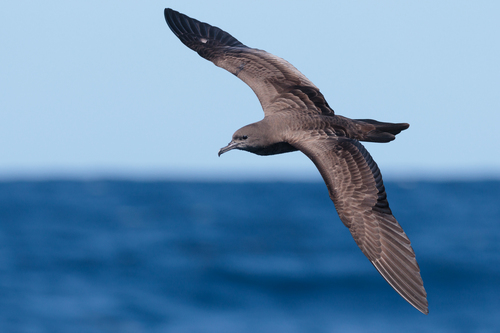
Wedge-tailed Shearwater
Ardenna pacifica
Often called the 'moaning bird' for its ghostly nocturnal wails, this incredible voyager travels thousands of miles across the ocean before returning to the exact same coastal burrow every year.
Quick Identification
Size
Length: 38–46 cm (15–18 in); Wingspan: 97–105 cm (38–41 in); Weight: 300–550 g (11–19 oz)
Colors
Exists in two color morphs. Dark morph: uniform chocolate-brown. Pale morph: grey-brown upperparts with white underparts. Both have flesh-pink legs and a greyish bill.
Key Features
- Distinctive long, wedge-shaped tail visible in flight
- Slender hooked bill with prominent tubular nostrils (tubenose)
- Long, narrow wings with a rhythmic 'shearing' flight style
- Pinkish-flesh colored legs and feet positioned far back on the body
When You’ll See Them
Behavior
The Wedge-tailed Shearwater is a master of the open ocean, spending the vast majority of its life at sea. They are highly social during the breeding season, congregating in massive colonies on offshore islands and coastal cliffs. They are famous for their vocalizations at night; their mournful, rhythmic wailing has earned them the nickname 'moaning bird' in many Pacific cultures, as the sound often resembles the crying of a human infant or a ghost.
On land, these birds are awkwardly adapted, using their wings and beaks to help pull themselves along because their legs are positioned specifically for swimming rather than walking. They are monogamous and return to the same burrow year after night after year. Despite their clumsy land movements, they are incredibly dedicated parents, with both the male and female sharing incubation and chick-rearing duties for several months before the chick fledges and heads to sea alone.
EverydayEarth exclusive
Camera Tips
Capturing the Wedge-tailed Shearwater on a trail camera requires targeting their nesting sites, as these are the only times they come ashore. If you live on a coastal property near a colony, look for burrow entrances—holes roughly 4-6 inches wide in sandy soil or under coastal scrub like Naupaka. Place your camera on a low mount or even directly on the ground, angled slightly upward to face the burrow entrance from a distance of 3-5 feet. Because these birds are strictly nocturnal on land to avoid predators, you must use a camera with high-quality infrared (IR) night vision. Never use a white-light flash, as shearwaters are highly susceptible to light disorientation, which can cause them to crash into structures or abandon their burrows.
Setting your camera to video mode is often more rewarding than still photos. The 'moaning' calls are a significant part of their behavior, and a 15-20 second video clip will capture the eerie audio along with their social interactions. If your camera has a 'Hybrid' mode (taking a photo then a video), use it to get high-resolution identification shots alongside behavior footage. During the peak of the breeding season, you may capture pairs 'allopreening' (cleaning each other's feathers) outside the burrow entrance, which is a fantastic behavior to document.
Timing is critical for success. The best window for camera activity is during the fledging season—typically late October through November in Hawaii. This is when the large, downy chicks emerge from their burrows to stretch their wings and prepare for their first flight. Be mindful of the environment; coastal salt spray is extremely corrosive to electronics. Even 'weatherproof' cameras should be wiped down with a damp fresh-water cloth every few days, and using a protective security box can help shield the lens from salt crusting which can blur your night shots.
Similar Species
Species that look similar or are commonly confused with Wedge-tailed Shearwater.
Sooty Shearwater
Darker overall with silvery patches under the wings and a much shorter, rounded tail compared to the Wedge-tailed.
Short-tailed Shearwater
Smaller with a shorter bill and darker underwings; lacks the distinct long, wedge-shaped tail profile.
Buller's Shearwater
Features a striking 'M' pattern across its wings in flight and has much cleaner, brighter white underparts.
Frequently Asked Questions
Record Wedge-tailed Shearwater at your habitat
Connect a camera to start building your own species record — AI identifies every visitor automatically.