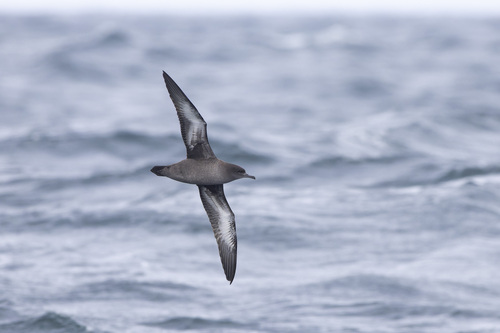
Sooty Shearwater
Ardenna grisea
The ultimate ocean wanderer, the Sooty Shearwater travels tens of thousands of miles each year in a spectacular global loop. Witness the bird that 'flies' underwater and dominates the coastal winds with effortless grace.
Quick Identification
Size
Length 40–51 cm (16–20 in); Wingspan 94–110 cm (37–43 in); Weight 650–950 g (1.4–2.1 lbs)
Colors
Uniform dark sooty-brown plumage appearing almost black from a distance, featuring distinctive silvery-white patches on the underwing coverts; bill and legs are dark gray to blackish.
Key Features
- Distinctive silvery-white underwing flashes visible during flight
- Slender, dark bill with hooked tip and tubular nostrils
- Stiff-winged 'shearing' flight style, tilting from side to side
- Long, narrow wings designed for high-speed gliding
When You’ll See Them
Behavior
The Sooty Shearwater is one of nature's most impressive travelers, famous for its massive 'figure-eight' migration that covers up to 40,000 miles annually. They are highly social birds, often seen at sea in 'rafts' numbering in the thousands. While they spend the majority of their lives over the open ocean, they are remarkably agile both in the air and underwater. Using their wings to literally 'fly' through the water, they can dive to staggering depths in pursuit of prey.
When they return to land for breeding, typically on islands in the Southern Hemisphere, their behavior shifts dramatically. To avoid predators like gulls and skuas, they become strictly nocturnal on land, arriving at their nesting burrows under the cover of darkness. They are known for their haunting, rhythmic vocalizations at breeding colonies, which sound like a mix of croaks and high-pitched wails. To humans, they are often a symbol of the wild, untameable ocean, though they are vulnerable to light pollution which can disorient fledglings.
EverydayEarth exclusive
Camera Tips
Capturing a Sooty Shearwater on a trail camera is a unique challenge because they are almost never on solid ground except at their nesting sites. If you live on a coastal property overlooking a known flyway or near a breeding colony, your best bet is to position your camera on a high vantage point, such as a cliff edge or a balcony with a clear view of the horizon. Set your camera to 'High-Speed' or 'Sport' mode if available, as these birds move at incredible speeds and will appear as a dark blur on standard settings. Use a fast shutter speed to freeze the motion of their wings and capture that iconic silvery underwing flash.
For those living near breeding colonies in New Zealand, Australia, or Chile, placing a camera near a burrow entrance can yield fascinating nocturnal footage. Since these birds are active at night on land, ensure your camera has high-quality 'No-Glow' infrared LEDs to avoid scaring them or attracting predators to the burrow. Set the camera low to the ground, about 6-10 inches high, angled slightly upward toward the burrow mouth. Passive Infrared (PIR) sensors are great here, but because shearwaters can be slow to enter the burrow, a short video trigger (10-15 seconds) is better than a still photo.
Salt spray is the biggest enemy of electronics in shearwater territory. If your camera is positioned near the ocean, use a protective housing or a silicone cover, and be prepared to wipe the lens with a microfiber cloth frequently. Avoid using traditional baits or lures; these birds are not attracted to backyard birdseed or suet. Instead, they are drawn to the natural topography of the land. If you are monitoring a burrow, ensure you do not disturb the soil or the entrance, as shearwaters are highly sensitive to changes in their nesting environment.
Finally, timing is everything. Use the seasonal migration patterns to your advantage. In the Pacific Northwest or Atlantic coasts of North America, the best time for 'backyard' ocean-facing cameras is during their northward trek in late spring or their return south in late summer. For Southern Hemisphere residents, the peak of activity is during the summer months when parents are constantly shuttling food back to hungry chicks. Adjust your camera's sensitivity to 'High' to account for the fast-moving birds against the relatively uniform background of the sea.
Similar Species
Species that look similar or are commonly confused with Sooty Shearwater.
Short-tailed Shearwater
Slightly smaller with a shorter bill and darker, more uniform gray underwings.
Pink-footed Shearwater
Easily distinguished by its mottled white underparts and distinctive pinkish bill and feet.
Great Shearwater
Has a distinct dark cap, a white 'collar' on the neck, and white patches at the base of the tail.
Frequently Asked Questions
Record Sooty Shearwater at your habitat
Connect a camera to start building your own species record — AI identifies every visitor automatically.