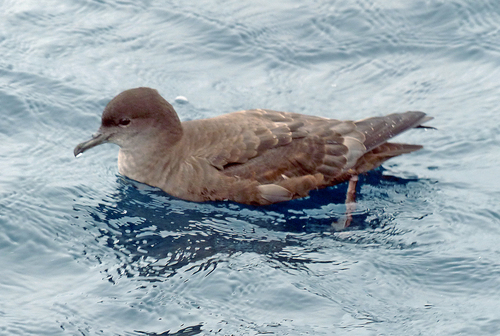
Short-tailed Shearwater
Ardenna tenuirostris
Meet the ultimate long-distance traveler of the Australian coast. Known for their epic 30,000km migration, Short-tailed Shearwaters transform quiet coastal dunes into bustling midnight cities during the breeding season.
Quick Identification
Size
Length: 40–45 cm (16–18 in); Wingspan: 95–100 cm (37–39 in); Weight: 500–800 g (1.1–1.8 lbs)
Colors
Uniformly dark sooty-brown plumage overall with subtle silvery-grey linings on the underwings; dark grey hooked bill and dark legs.
Key Features
- Uniform dark sooty-brown plumage with pale grey underwing linings
- Short, rounded tail and slender dark bill with a hooked tip
- Distinctive 'stiff-winged' flight pattern low over the ocean waves
When You’ll See Them
Behavior
Short-tailed Shearwaters are master mariners, spending the majority of their lives at sea. They are famous for their incredible 30,000-kilometer annual migration, tracing a giant figure-eight across the Pacific Ocean to spend the northern summer in the Aleutian Islands before returning to southern Australia to breed. On land, they are clumsy but social, gathering in massive colonies that can number in the millions.
During the breeding season, they exhibit a fascinating 'rafting' behavior where thousands of birds sit on the water's surface just offshore, waiting for dusk to fly inland to their burrows. While they generally avoid direct human contact, they are a significant part of coastal Australian culture, particularly in Tasmania where they are traditionally harvested. They communicate with loud, eerie 'pick-u' calls that can make a nesting colony sound quite haunted at night.
EverydayEarth exclusive
Camera Tips
Capturing the Short-tailed Shearwater on camera is a unique challenge because they are almost exclusively active on land under the cover of darkness. If you live near a coastal breeding colony, position your camera about 12 to 18 inches off the ground, angled slightly downward toward the entrance of a known burrow. Because these birds are clumsy on land and often 'crash land' into the scrub, a wide-angle lens is essential to capture the action as they scramble toward their underground homes.
Using a camera with high-quality No-Glow Infrared (IR) LEDs is critical. Standard white flash will startle the birds and may disrupt their nesting behavior, while 'Low-Glow' IR can sometimes be seen by the birds and cause them to avoid the area. Set your camera to video mode or a high-speed burst photo mode; the movement from the air to the burrow is extremely fast, and a single shot often results in a blurry wing or a tail disappearing into the dark. A trigger speed of 0.2 seconds or faster is ideal.
Timing is everything with 'Muttonbirds.' The best footage is captured between late November and early April. Set your camera to be active only from dusk until dawn to conserve battery and storage. You don't need food lures—their strong instinct to return to their specific burrow is more than enough to bring them into frame. In fact, avoid placing any bait, as this might attract predators like feral cats or foxes that prey on the shearwaters.
Lastly, pay attention to the wind. These birds use the wind to help them land in thick coastal vegetation. On nights with a strong onshore breeze, they are more likely to land closer to their burrows with precision. Position your camera on the leeward side of shrubs where birds are likely to scramble for cover after landing. Ensure your housing is weather-sealed, as salt spray and sand can quickly damage electronics in these harsh coastal environments.
Similar Species
Species that look similar or are commonly confused with Short-tailed Shearwater.
Sooty Shearwater
Slightly larger with a longer bill and more conspicuous bright white patches on the underwings.
Flesh-footed Shearwater
Easily identified by its pale pinkish bill with a dark tip, whereas the Short-tailed has an all-dark bill.
Wedge-tailed Shearwater
Has a noticeably longer, wedge-shaped tail and is more common in warmer tropical waters.
Frequently Asked Questions
Record Short-tailed Shearwater at your habitat
Connect a camera to start building your own species record — AI identifies every visitor automatically.