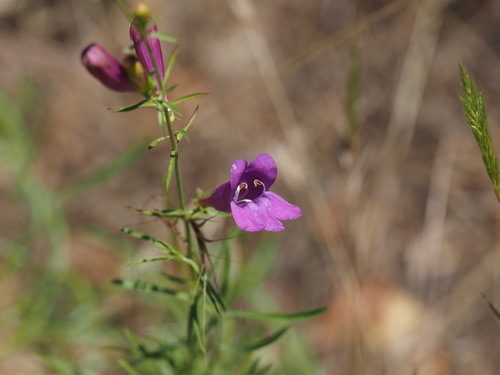
Bunchleaf Penstemon
Penstemon heterophyllus
A California native masterpiece, the Bunchleaf Penstemon electrifies backyards with its stunning towers of sapphire and violet blossoms.
Quick Identification
Size
Height: 30-60 cm (1-2 ft); Spread: 60-90 cm (2-3 ft)
Colors
Brilliant electric blue to deep purple tubular flowers; narrow, gray-green to bright green foliage.
Key Features
- Trumpet-shaped blossoms with two-lipped openings
- Narrow, lance-shaped leaves arranged oppositely along the stems
- Woody-based perennial with a mounding, shrubby growth habit
- Flowers often display a 'shimmer' of blue and violet on the same petal
When You’ll See Them
Geographic range
Where Does the Bunchleaf Penstemon Live?
Native to the North American continent, the Bunchleaf Penstemon is a true California specialist. It is endemic to the California Floristic Province, where it is found sprawling across the Coast Ranges and the foothills of the Sierra Nevada mountains. This species is perfectly adapted to the Mediterranean climate of the West Coast, though it has gained popularity in drought-tolerant landscapes throughout the southwestern United States and similar climates globally.
Basemap © OpenStreetMap contributors
Behavior
The Bunchleaf Penstemon is a hardy, woody-based perennial that is a cornerstone of the California chaparral ecosystem. Unlike many delicate garden flowers, this species is built for survival, featuring a deep taproot and narrow leaves that minimize water loss during the hot, dry summers of its native range. It follows a seasonal cycle of growth, exploding into a dense 'bunch' of foliage in early spring followed by a spectacular vertical display of blooms that lasts for several months.
As a key nectar source, it acts as a social hub for local wildlife. While the plant itself remains stationary, it exhibits 'behavior' through its interactions with the environment—turning its flower heads toward the sun and providing a sturdy landing platform for heavy pollinators like bumblebees. It is particularly known for its relationship with hummingbirds, which are drawn to the tubular shape of the flowers and can be seen visiting the plant repeatedly throughout the morning hours.
EverydayEarth exclusive
Camera Tips
To capture the best images of Bunchleaf Penstemon, position your camera on a low tripod or a ground stake roughly 2 to 3 feet away from the main flower cluster. Because these flowers are relatively low to the ground, an upward-tilted angle provides a more dramatic perspective, making the plant look like a 'forest' of blue spires. Since the primary goal of monitoring this plant is often to see the pollinators it attracts, use a camera with a fast trigger speed or high-frame-rate video settings to catch the rapid movements of hummingbirds and bees.
Lighting is critical for this species because of its unique 'electric' blue color. The petals have a metallic quality that can look washed out in the harsh midday sun. Set your camera to capture time-lapse photos or videos during the 'golden hours' of early morning (6-8 AM) or late afternoon (5-7 PM). The soft, angled light during these times will make the blue and violet hues pop and highlight the fine hairs and textures on the flower stems.
For AI-powered cameras, set up a detection zone specifically around the flower heads. This will ensure you don't miss the fast-moving Western Honeybees or Anna’s Hummingbirds that are frequent visitors. If you are using a trail camera, ensure the focal length is set for close-up work, as many standard trail cams are fixed-focus for larger animals. Adding a macro lens attachment can transform your footage into a professional-grade look at the intricate inner markings of the 'beardtongue' flower.
Similar Species
Species that look similar or are commonly confused with Bunchleaf Penstemon.
Frequently Asked Questions
Record Bunchleaf Penstemon at your habitat
Connect a camera to start building your own species record — AI identifies every visitor automatically.