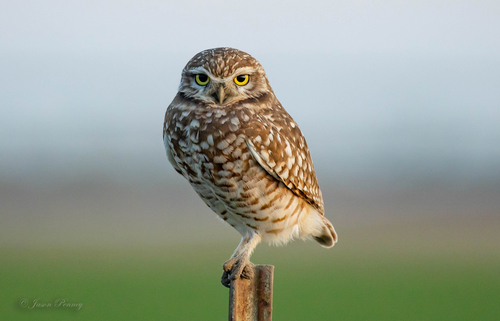
Burrowing Owl
Athene cunicularia
Meet the long-legged sentinel of the grasslands. These charismatic owls live underground and are famous for their comical 'bowing' behavior and fierce day-time guarding of their burrows.
Quick Identification
Size
Length: 19-28 cm (7.5-11 in); Wingspan: 51-61 cm (20-24 in); Weight: 140-240 g (5-8.5 oz)
Colors
Mottled brown and sandy-cream plumage with white spots; distinctive white chin patch and 'eyebrows'; bright yellow eyes
Key Features
- Extraordinarily long, sparsely feathered legs
- Bright yellow eyes with no ear tufts
- Compact, sandy-brown body with white spotting
- Stands upright on the ground or on low perches
When You’ll See Them
Geographic range
Where Does the Burrowing Owl Live?
Native to the vast open landscapes of North and South America, the Burrowing Owl maintains a sprawling range that stretches from the southern prairies of Western Canada through the American West and down into the tip of Argentina. While they are a staple of the Great Plains and the Florida peninsula in the United States, they are also found across the Caribbean and throughout the South American pampas. In the northern reaches of their territory, populations are migratory, heading south to Mexico and Central America for the winter, while those in tropical and southern regions are typically year-round residents.
Basemap © OpenStreetMap contributors
Behavior
Unlike most owls, Burrowing Owls are highly active during the day, though they prefer the cooler temperatures of dawn and dusk for hunting. They are famous for their unique habit of living in underground burrows, which they often 'decorate' with animal dung, feathers, and trash to attract insect prey. When disturbed or curious, they perform a comical 'bowing' motion, bobbing their heads up and down to improve their depth perception.
These owls are social compared to other raptors, sometimes nesting in small colonies where they act as sentinels, standing guard at the entrance of their tunnels. They are highly vocal, using a variety of chatters, clucks, and a distinctive 'coo-coooo' call. While they are capable of strong flight, they spend a significant amount of time walking or running across the ground in pursuit of prey.
EverydayEarth exclusive
Camera Tips
To capture the best footage of Burrowing Owls, position your camera 10 to 15 feet away from a known active burrow entrance. Because these birds are ground-dwellers, mount your camera very low—ideally no more than 6 to 12 inches off the ground—using a stake or a specialized low-profile ground mount. Angle the lens slightly upward to capture the owls standing tall or performing their signature bowing behavior. If you are in an area with livestock, ensure your camera is protected by a security box, as cattle are notorious for rubbing against equipment.
Since these owls are active during the day, you don't have to rely solely on infrared night vision. Use a camera with a fast trigger speed and set it to burst mode or short video clips; their movements can be surprisingly quick when they are pouncing on insects. In the heat of the day, they may retreat into the burrow, so the 'golden hours' of morning and evening are your best bet for high-activity shots. Avoid placing the camera directly in front of the burrow mouth, as you don't want to obstruct their flight path or make them feel threatened.
A pro-tip for attracting them to your camera's field of view is to recognize their natural foraging habits. Burrowing Owls often use mammal dung to lure in dung beetles. If you notice them bringing manure to their burrow, place your camera to cover the area where the dung is being deposited. Never use artificial baits or audio lures, as these can stress the birds and disrupt their natural hunting patterns. During the spring and summer, keep your camera running 24/7 to catch the adorable moment when the fluffier owlets emerge from the burrow for the first time.
Similar Species
Species that look similar or are commonly confused with Burrowing Owl.
Frequently Asked Questions
Record Burrowing Owl at your habitat
Connect a camera to start building your own species record — AI identifies every visitor automatically.