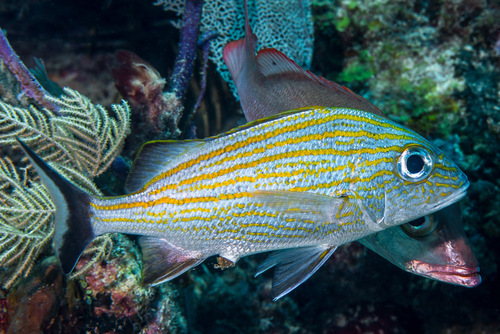
Caesar Grunt
Haemulon carbonarium
Meet the bronze-striped socialite of the Atlantic reefs. Known for its nocturnal hunts and distinct grunting calls, the Caesar Grunt is a vibrant staple of Caribbean marine life.
Quick Identification
Size
Average length of 20–25 cm (8–10 in), with a maximum recorded length of 36 cm (14 in); weight typically up to 0.7 kg (1.5 lbs).
Colors
Silvery-white body decorated with horizontal bronze-to-yellow stripes; the tail (caudal) and soft dorsal fins are characteristically dusky or blackish; the mouth interior is bright red.
Key Features
- Bronze-yellow horizontal stripes along the flanks
- Dusky to blackish tail and soft dorsal fin
- Bright red interior of the mouth
- Deep, compressed body shape typical of the grunt family
- Large, forward-set eyes
When You’ll See Them
Geographic range
Where Does the Caesar Grunt Live?
The Caesar Grunt is native to the tropical and subtropical waters of the Western Atlantic Ocean. Its range begins as far north as Bermuda and the southern coast of Florida, extending through the Bahamas and the Gulf of Mexico. It is a common sight throughout the Caribbean Sea, following the coastline of Central and South America down to the northern reefs of Brazil. This species is a hallmark of the West Indies reef systems, thriving in the clear, warm waters of the Atlantic basin.
Basemap © OpenStreetMap contributors
Behavior
Caesar Grunts are highly social fish that are most frequently observed in large, stationary schools during the daylight hours. They tend to hover near coral formations, rocky ledges, or under the shade of piers to avoid predators. These daytime gatherings are purely social and defensive; they rarely feed while schooling in the light.
As night falls, the social structure changes. The schools disperse as individual fish move toward seagrass beds and sandy flats to forage for food. They are famous for the 'grunting' sound that gives their family its name, produced by grinding their pharyngeal teeth together and using their swim bladder to amplify the noise. This sound is often a response to stress or a means of communication within the reef community.
EverydayEarth exclusive
Camera Tips
Capturing high-quality footage of the Caesar Grunt requires an underwater camera setup, such as a waterproof action camera or an AI-powered reef cam housed in a pressure-sealed casing. To catch them in their most natural state, place your camera near a 'cleaning station'—a specific spot on the reef where smaller fish pick parasites off larger ones. Caesar Grunts often hover in these areas during the day. Position the camera at a low angle, roughly 1 foot off the seabed, tilted slightly upward to catch the sunlight reflecting off their bronze stripes.
Because these fish are nocturnal foragers, your camera’s low-light performance or infrared (IR) capabilities are essential. If you are monitoring a dock or a backyard saltwater canal, try mounting the camera on a piling facing a patch of sandy bottom or seagrass. The transition between the structure (where they hide during the day) and the grass (where they eat) is a high-traffic corridor. Ensure the lens is clear of 'biofouling'—the growth of algae or barnacles—by cleaning the housing at least once a week.
Using a gentle underwater light can act as a natural attractant, as it draws in the small crustaceans and worms that Caesar Grunts feed on at night. However, avoid overly bright, flickering lights which might spook the fish. For the most cinematic AI triggers, set your camera to a high frame rate (60fps or higher) to capture the quick, snapping motions they make when diving into the sand for prey. This will provide the AI with the clearest frames for species identification and behavioral analysis.
Similar Species
Species that look similar or are commonly confused with Caesar Grunt.
French Grunt
French Grunts have yellow stripes that run diagonally on the lower half of the body, whereas Caesar Grunt stripes are strictly horizontal.
Bluestriped Grunt
Features bright blue horizontal stripes and a much darker, almost black tail fin compared to the bronze tones of the Caesar Grunt.
Tomtate
Lacks the full-body bronze stripes, typically showing only two main yellow stripes and a prominent black spot at the base of the tail.
Frequently Asked Questions
Record Caesar Grunt at your habitat
Connect a camera to start building your own species record — AI identifies every visitor automatically.