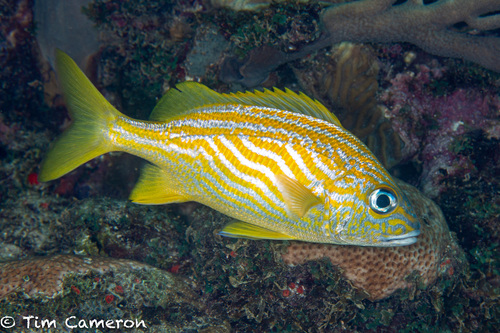
French Grunt
Haemulon flavolineatum
A vibrant icon of the Atlantic reefs, the French Grunt is easily recognized by its golden stripes and its unique ability to 'grunt' using its teeth. These social fish create spectacular underwater displays as they school by the hundreds along sun-drenched coral ledges.
Quick Identification
Size
Typically 15 to 25 cm (6 to 10 in) in length, with a maximum recorded size of 30 cm (12 in).
Colors
Brilliant silvery-white body with bold golden-yellow stripes; fins are entirely yellow.
Key Features
- Diagonal yellow stripes above the lateral line
- Horizontal yellow stripes below the lateral line
- Bright red interior of the mouth
- Deeply forked yellow tail fin
- Large, dark eyes positioned forward on the head
When You’ll See Them
Sightings on EverydayEarth
Jun 29, 2026
A vibrant underwater scene on a Caribbean reef. Large schools of Bluehead Wrasse and Atlantic Sergeant Majors are actively swimming and foraging among sea fans and plumes. A few Blue Chromis are hovering in the open water while French Grunts move slowly through the lower portion of the frame.
Jun 20, 2026
A diverse array of tropical reef fish are active around a large sea fan and coral outcropping. A large Stoplight Parrotfish in its terminal phase swims gracefully from left to right across the foreground. Several Blue Tangs are visible in the background, while schools of French Grunts and Sergeant Majors move through the water column. Smaller Bicolor Damselfish are seen hovering close to the safety of the reef structure.
Jun 3, 2026
The underwater scene is busy with reef life. A French Grunt slowly swims across the lower portion of the frame over the coral. Mid-way through the footage, a terminal phase male Bluehead Wrasse swims directly in front of the camera, showing off its vibrant colors. Small Blue Chromis and other juvenile fish are visible in the background, hovering near the sea fans and coral heads.
Jun 2, 2026
A vibrant reef scene shows multiple fish species active around large gorgonian sea fans. A French Grunt remains relatively stationary in the lower left, while Bicolor Damselfish dart between the coral and sponges. In the background, small Blue Chromis swim in the open water above the reef wall.
May 22, 2026
A vibrant reef scene teeming with life. A French Grunt hovers steadily near the base of the reef, while several Bicolor Damselfish and juvenile Bluehead Wrasse dart through the swaying sea fans and soft corals. The water is clear, allowing for a detailed view of the reef's complex structure and its inhabitants.
May 19, 2026
A vibrant coral reef is teeming with activity as various fish species navigate through swaying sea fans. An Atlantic Sergeant Major is clearly visible swimming downward, showcasing its black vertical bars. A French Grunt passes through the upper right, while several small Blue Chromis dart through the water in the background. Near the reef floor, a Tomtate rests among the corals and sponges.
Geographic range
Where Does the French Grunt Live?
The French Grunt is a native of the Western Atlantic Ocean, spanning a wide tropical and subtropical range from Bermuda and South Carolina down through the Caribbean Sea and the Gulf of Mexico. This species is particularly abundant around the island nations of the Bahamas and the Antilles, where coral reef health is most robust. Their range continues along the Central American coastline and extends as far south as the coast of Brazil, though they are rarely found in the cooler waters further north of the Carolinas.
Basemap © OpenStreetMap contributors
Behavior
French Grunts are highly social marine fish that are most famous for their habit of forming massive, shimmering schools during the day. These schools typically gather around large coral structures, such as elkhorn or staghorn corals, or tuck under rocky ledges to find safety from predators. While schooling, they exhibit a rhythmic swaying motion, moving in unison with the ocean’s surge. Their common name refers to the audible 'grunting' sound they produce by grinding their pharyngeal teeth together, a sound that is amplified by their gas-filled swim bladder.
As the sun sets, the tight-knit schools break apart as individuals venture out into the surrounding seagrass beds and sand flats. This nocturnal migration is driven by their need to hunt for food away from the competitive environment of the reef. They are generally peaceful and are a staple sight for snorkelers and divers throughout the Caribbean, though they remain wary of larger predatory fish like groupers and snappers.
EverydayEarth exclusive
Camera Tips
To capture the French Grunt on an AI-powered camera, you will need a waterproof housing and a stable mounting system. If you are placing a camera near a backyard dock or a private reef area, use a weighted tripod to keep the lens steady against the current. Positioning the camera near structured cover—like a rock pile or a patch of coral—is essential, as this is where the grunts will congregate during the day to rest and socialize.
Lighting is the biggest challenge for underwater captures. During the day, try to position your camera so the sun is behind it; this illuminates the golden-yellow stripes of the fish without creating a silhouette. For night shots, when the French Grunt is most active for feeding, use a diffused external light source. Avoid high-intensity white strobes which can wash out their silvery scales; a softer, wide-angle video light will provide a much more natural look at their nocturnal behavior.
Since French Grunts often move in schools, use a wide-angle lens to capture the scale of the group. If your camera supports high frame rates, record at 60fps or higher to smoothly document the shimmering 'wall of gold' effect created by their synchronized swimming. If you are observing from a dock or pier, consider a vertical drop-mount that keeps the camera at a consistent depth, as these fish prefer to stay within the middle or bottom of the water column rather than near the surface.
Similar Species
Species that look similar or are commonly confused with French Grunt.
Bluestriped Grunt
The stripes are blue instead of yellow and run entirely horizontal across the body.
White Grunt
Smaller blue and yellow stripes are only on the head, with a more silvery, checkered body pattern.
Smallmouth Grunt
Has much thinner, paler horizontal stripes and a noticeably smaller mouth.
Frequently Asked Questions
Record French Grunt at your habitat
Connect a camera to start building your own species record — AI identifies every visitor automatically.