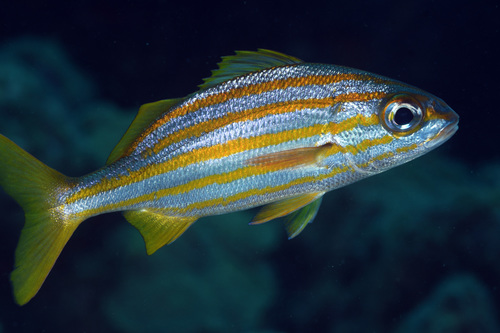
Smallmouth Grunt
Brachygenys chrysargyrea
A shimmering masterpiece of the western Atlantic, the Smallmouth Grunt brings a splash of golden stripes to every reef and dock. Watch as these social 'vocalists' transform from quiet daytime schools into agile nocturnal hunters.
Quick Identification
Size
Typically 15-23 cm (6-9 inches) in length; weighs approximately 0.1-0.3 kg (0.2-0.7 lbs)
Colors
Brilliant silvery-white body with 5-7 prominent horizontal yellow-to-bronze stripes; fins are often translucent yellow
Key Features
- Distinctive horizontal bronze-yellow stripes
- Small, slightly upturned mouth
- Deeply forked tail fin with a yellow tint
- Body color is silvery-white under the stripes
When You’ll See Them
Behavior
As night falls, the social structure changes. The schools disperse as individuals move away from the protection of the reef to forage in seagrass beds or over sandy bottoms. This nocturnal shift makes them a fascinating subject for 24-hour observation, as their personality shifts from a collective 'unit' in the daytime to independent hunters at night.
While they are generally peaceful and shy around larger creatures, they are quite curious about stationary objects. In areas where they are frequently observed by humans, they may become bolder, though they rarely interact directly with people unless food is involved.
EverydayEarth exclusive
Camera Tips
Because they are most active as hunters at night, using a camera with infrared or low-light capabilities is a game-changer. Avoid using bright white LEDs if possible, as these can startle the school and cause them to scatter. Instead, look for cameras with 'green light' attractants or subtle red-light modes. These spectrums are less disruptive to the fish and can actually attract the small plankton they feed on, bringing the grunts directly in front of your lens for a close-up feeding show.
For those with a backyard dock, a 'chum' bag filled with crushed crustacean shells or fish scraps can be hung just out of the camera's view. This doesn't just attract the Smallmouth Grunts; it keeps the school localized in your camera's frame for longer periods. Ensure your camera is set to a high bitrate or 'Sport' mode if available; while they look like they are floating still, their micro-movements and the shimmering of their scales require high detail to prevent motion blur.
Finally, consider the water clarity. The best footage is captured 1-2 days after a storm once the sediment has settled. In clearer water, AI-powered cameras can more easily distinguish the horizontal stripes of the Smallmouth Grunt from other similar species, ensuring your species log is accurate and your video is crisp enough to see the texture of their fins.
Similar Species
Species that look similar or are commonly confused with Smallmouth Grunt.
French Grunt
French Grunts have diagonal stripes on the lower half of their body, whereas the Smallmouth Grunt's stripes are all horizontal.
Bluestriped Grunt
Bluestriped Grunts are larger with blue-toned stripes and a much darker tail fin compared to the yellow-toned Smallmouth Grunt.
Tomtate
The Tomtate has fewer stripes and a very distinct black spot at the base of its tail fin.
Frequently Asked Questions
Record Smallmouth Grunt at your habitat
Connect a camera to start building your own species record — AI identifies every visitor automatically.