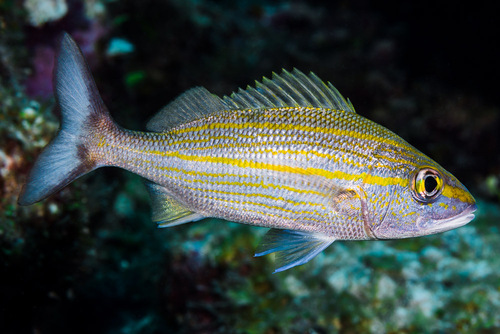
Tomtate
Haemulon aurolineatum
The Tomtate is the shimmering socialite of the Atlantic reefs, recognized by its bold yellow racing stripe and signature 'grunting' call. A common delight for coastal residents, these silver fish turn underwater pilings into bustling aquatic neighborhoods.
Quick Identification
Size
6 to 9 inches (15 to 23 cm) in length; typically weighs 0.5 to 1.1 lbs (0.2 to 0.5 kg)
Colors
Shimmering silver-white body with a prominent yellow-bronze stripe running from the snout through the eye to the tail; often features a second, fainter parallel stripe above the main one
Key Features
- Bold yellow stripe from eye to tail
- Distinctive black spot at the base of the tail fin (caudal fin)
- Inside of the mouth is a bright, vivid red
- Oblong silver body with a slightly notched dorsal fin
When You’ll See Them
Sightings on EverydayEarth
Jun 2, 2026
A diverse array of reef life is active around large sea fans. A Bicolor Damselfish hovers territorially near the coral base, while a Tomtate swims slowly through the lower foreground. Above them, several small Caribbean Bluehead Wrasse in their bright yellow phase dart through the water column alongside other small reef fish.
May 19, 2026
A vibrant coral reef is teeming with activity as various fish species navigate through swaying sea fans. An Atlantic Sergeant Major is clearly visible swimming downward, showcasing its black vertical bars. A French Grunt passes through the upper right, while several small Blue Chromis dart through the water in the background. Near the reef floor, a Tomtate rests among the corals and sponges.
Behavior
While they are somewhat cautious, they are common sights for snorkelers and divers in coastal waters. They often move in synchronized pulses, shifting as a single unit when a predator—or a curious human—gets too close. At night, the schools disperse as individuals head out to sandy flats or seagrass beds to forage for food, returning to their 'home' structure as the sun rises.
EverydayEarth exclusive
Camera Tips
Since Tomtates are most active as feeders at night, look for a camera with high-quality infrared (IR) night vision or utilize a low-intensity, red-filtered underwater light to avoid startling them. If you are recording during the day, try to position the camera so the sun is behind the lens; this will make their silver scales and yellow stripes 'pop' against the blue or green water. Avoid placing the camera in direct high-surge areas where bubbles and debris might obscure the lens.
Baiting is an excellent way to bring a school directly in front of your lens. Secure a small mesh 'chum bag' filled with crushed shrimp or frozen fish scraps about 18 inches away from the camera. The scent will quickly draw in a crowd. For settings, use a frame rate of at least 60fps. This allows you to use slow-motion during playback to see the unique 'grunting' mouth movements and the rapid-fire pectoral fin adjustments they make to stay stationary in a current. Finally, plan your recording sessions around high tide when the water is typically clearest, as murky water can make AI identification much more difficult.
Similar Species
Species that look similar or are commonly confused with Tomtate.
French Grunt
French Grunts have diagonal yellow stripes and lack the distinctive dark spot at the base of the tail.
White Grunt
White Grunts are larger and feature narrow blue and yellow stripes only on the head, with a more checkered body pattern.
Smallmouth Grunt
Features five or six golden-yellow horizontal stripes and a much more deeply forked tail than the Tomtate.
Frequently Asked Questions
Record Tomtate at your habitat
Connect a camera to start building your own species record — AI identifies every visitor automatically.