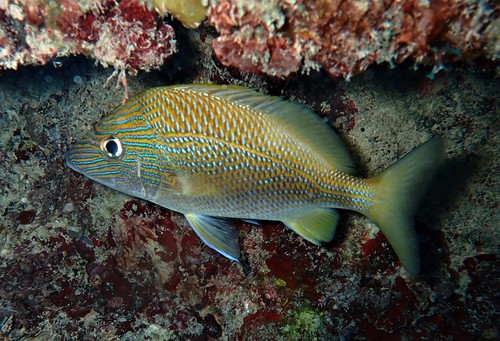
White Grunt
Haemulon plumierii
The White Grunt is the vocal socialite of the Atlantic reefs, recognized by its shimmering silver body and the surprising splash of red inside its mouth. These 'grunting' fish are a staple sight for coastal observers and a favorite for underwater photography.
Quick Identification
Size
Typically 12-18 inches (30-45 cm) in length; weights range from 1 to 4 lbs (0.45-1.8 kg).
Colors
Silvery-cream body with horizontal yellow and blue stripes primarily on the head; scales on the body often have bronze or yellowish edges.
Key Features
- Distinctive blue and yellow longitudinal stripes on the head and face
- Interior of the mouth is a vivid, bright red or orange
- Deep notch in the dorsal fin and a slightly forked tail
- Produces a 'grunting' sound by grinding its pharyngeal teeth together
When You’ll See Them
Behavior
White Grunts are highly social fish known for their schooling behavior. During the daylight hours, they congregate in large, shimmering groups around coral reefs, shipwrecks, and rocky jetties for protection against predators. While they appear relatively passive during the day, they are actually quite territorial regarding their personal space within the school and may engage in 'mouth-to-mouth' pushing matches to establish dominance.
As the sun sets, the school disperses. White Grunts are primarily nocturnal foragers, moving away from the safety of the reef to sandy flats and seagrass beds to hunt for prey. They are famously vocal; when stressed or handled, they produce a distinct grunting noise by rubbing their teeth together, which is amplified by their swim bladder—a fascinating acoustic behavior that gives the species its name.
EverydayEarth exclusive
Camera Tips
To capture high-quality footage of White Grunts, your camera placement should focus on 'structure.' If you have a dock or waterfront property, mount your waterproof camera or drop-rig near the base of pilings where the fish naturally congregate for shade. Use a weighted tripod or a suction mount to keep the camera steady against the current, and angle the lens slightly upward to catch the silvery shimmer of their scales as they catch the light.
Since White Grunts are most active as hunters at night, night-vision or infrared (IR) capabilities are essential. If using a camera with a white-light flash, try to set it to a lower intensity to avoid 'blowing out' the reflective silvery skin of the fish. If your camera setup allows for audio recording, ensure the housing is thin enough to capture sound; the unique grinding 'grunt' of these fish is a fantastic addition to any wildlife recording, especially if they are interacting with other fish.
For those looking to draw them into view, a small mesh bait bag filled with crushed shrimp or squid tied just within the camera's field of view will trigger their natural foraging instincts. However, be mindful of the tide; the best footage is usually captured during slack tide or slow-moving water when the fish are less focused on fighting the current and more focused on investigating your camera site. In winter months, look for them in slightly deeper, more stable water temperatures near offshore ledges.
Similar Species
Species that look similar or are commonly confused with White Grunt.
Bluestriped Grunt
Features blue and yellow stripes that run the entire length of the body, unlike the White Grunt which only has stripes on the head.
French Grunt
Has diagonal yellow stripes that appear to 'slant' compared to the horizontal orientation of other grunt species.
Pigfish
Similar shape and also grunts, but lacks the bright blue-and-yellow facial stripes and red mouth interior.
Frequently Asked Questions
Record White Grunt at your habitat
Connect a camera to start building your own species record — AI identifies every visitor automatically.