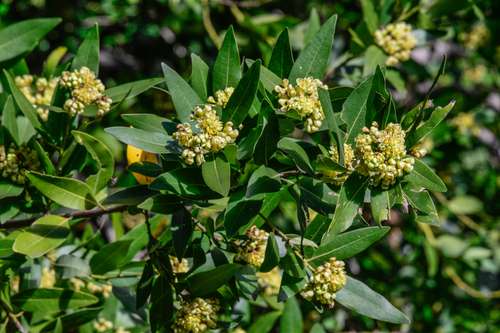
California bay
Umbellularia californica
The California bay is the pungent sentinel of Western forests, known for its spicy aroma and dense evergreen canopy. A cornerstone of the Pacific coast, it provides food and shelter for a vast array of backyard wildlife.
Quick Identification
Size
Typically 12-25 meters (40-80 feet) tall, but can reach 30 meters (100 feet) in ideal conditions.
Colors
Glossy dark green leaves, grayish-brown bark, and yellowish-green flower clusters.
Key Features
- Intensely aromatic leaves that smell spicy when crushed
- Long, lance-shaped leaves with smooth edges
- Small, round fruit that turns from green to dark purple
- Dense, rounded crown providing deep shade
When You’ll See Them
Geographic range
Where Does the California bay Live?
Native to the western coast of North America, the California bay thrives in the Mediterranean climate of the Pacific seaboard. Its core range extends from the Umpqua River valley in southern Oregon down through the California Coast Ranges and the foothills of the Sierra Nevada, reaching into the northern reaches of Baja California, Mexico. It is most commonly found in moist, shaded canyons and along permanent water sources where it can keep its roots cool.
Basemap © OpenStreetMap contributors
Behavior
The California bay, also known as the Oregon myrtle or pepperwood, is a hardy and long-lived evergreen that plays a vital role in its ecosystem. Unlike many other forest trees, it is highly adaptable, growing as a multi-stemmed shrub in dry, rocky areas or a massive, single-trunked giant in moist river valleys. It is famous for the chemical compound umbellulone in its leaves, which gives off a powerful, spicy aroma that can actually cause headaches if inhaled too deeply—earning it the nickname 'Headache Tree.'
This tree is a resilient survivor; it can resprout from its base after a wildfire and is often one of the first trees to reclaim disturbed ground. For humans, it provides beautiful 'myrtlewood' for woodworking and culinary leaves that serve as a potent (and much stronger) alternative to the traditional Mediterranean bay leaf. In the wild, its dense canopy offers critical nesting sites for birds and cooling shade for woodland mammals during the hot California summers.
EverydayEarth exclusive
Camera Tips
To capture the best wildlife action around a California bay, position your camera to face the ground near the base of the trunk during the late autumn months. This is when the tree drops its 'bay nuts'—fatty, avocado-like drupes. These are a high-calorie feast for squirrels, dusky-footed woodrats, and even mule deer. Setting your camera to a low angle will capture these foragers as they scramble to collect the fallen fruit before it rots or is taken by competitors.
Because the California bay has such a dense, dark canopy, lighting can be a challenge. Try to place your camera on the edge of the dripline where natural sunlight can penetrate the foliage, or use a camera with a high-quality infrared flash for clear nighttime shots. The tree's aromatic bark and low-hanging branches often serve as 'rubbing posts' for deer or scratching posts for bobcats; look for areas of the bark that appear smoother or discolored and aim your camera there at about 2-3 feet off the ground.
If you are interested in birdlife, mount your camera higher up (6-10 feet) facing a sturdy horizontal branch. Band-tailed pigeons and various scrub jays are frequently seen navigating the branches to reach the fruit. During the early spring (February-March), the clusters of yellow flowers attract a variety of pollinators and insect-eating birds. Use a fast shutter speed to capture the quick movements of these visitors against the dark green backdrop of the evergreen leaves.
Similar Species
Species that look similar or are commonly confused with California bay.
Bay Laurel
The Mediterranean bay laurel has shorter, more oval leaves and a much milder scent compared to the intense spice of the California bay.
Pacific Madrone
Madrone has reddish, peeling bark and clusters of red berries, whereas the California bay has grayish-brown bark and green/purple drupes.
Frequently Asked Questions
Record California bay at your habitat
Connect a camera to start building your own species record — AI identifies every visitor automatically.