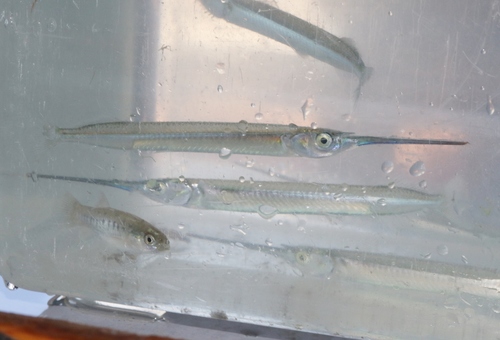
California Halfbeak
Hyporhamphus rosae
A sleek, silver surface-dweller of the Pacific coast, the California Halfbeak is famous for its needle-like body and its unique 'beaked' profile. Often seen skittering across the water in SoCal bays, this fascinating fish brings a touch of oceanic mystery to coastal backyards.
Quick Identification
Size
Typically 4 to 6 inches (10-15 cm) in length; very slender, needle-like profile.
Colors
Silvery-white underside with a translucent greenish or olive back; features a prominent silver lateral stripe running the length of the body.
Key Features
- Extremely elongated lower jaw (beak) with a reddish-orange tip
- Upper jaw is short and triangular
- Dorsal and anal fins set very far back near the tail
- Large eyes positioned for surface scanning
When You’ll See Them
Geographic range
Where Does the California Halfbeak Live?
Native to the Eastern Pacific coastline, the California Halfbeak is primarily found from the warm-temperate waters of Southern California down to the southern tip of Baja California and into the Gulf of California. Its range extends as far south as Mazatlán, Mexico, where it thrives in the nutrient-rich neritic zones near the shore. While not a migratory species in the traditional sense, they may shift slightly northward or deeper into estuaries during particularly warm El Niño events.
Basemap © OpenStreetMap contributors
Behavior
The California Halfbeak is a surface-dwelling specialist, often found in small, loose schools navigating the top few inches of the water column. They are known for their peculiar 'skittering' behavior; when startled by a predator or a passing boat, they use their powerful tails to propel themselves across the surface of the water, appearing to half-run and half-swim to safety.
These fish are generally shy and remain in constant motion, scanning the surface for food while staying alert for avian predators like herons and egrets. While not aggressive, they are highly social with their own kind, using their reflective silver sides to maintain school cohesion in the bright, shallow waters of bays and estuaries.
In human-populated coastal areas, they are frequently seen around docks and piers, particularly where lights attract the small plankton they feed upon at night. They are sensitive to water quality and serve as an informal indicator of the health of local estuarine ecosystems.
EverydayEarth exclusive
Camera Tips
Capturing the California Halfbeak requires an underwater camera setup or a high-angle pier-mounted rig. For the best results, mount an AI-powered camera (like a GoPro with a high-end sensor) roughly 6-12 inches below the water line on a dock piling or sea wall. Ensure the camera is pointed slightly upward toward the surface, as this species almost exclusively occupies the top layer of water. Using a polarized filter is essential to cut through the surface glare and capture the translucent greens of their backs.
Baiting is highly effective for drawing a school into the camera's field of view. A small mesh bag filled with crushed shrimp or high-protein fish meal suspended just below the surface will create a 'chum slick' that attracts halfbeaks. Because they are surface feeders, you can also sprinkle light floating pellets to keep them stationary in front of the lens for longer periods.
Timing is critical. In backyard lagoons or marinas, the best footage is often captured during high tide when the water is clearest and the fish move closer to the shore. If your camera setup allows for night recording, use a soft green or white underwater light. Halfbeaks are naturally drawn to light sources as they follow the phototactic plankton that congregate there after dark. Set your camera to a high frame rate (60fps or higher) to capture their rapid 'skittering' movements without motion blur.
Similar Species
Species that look similar or are commonly confused with California Halfbeak.
Frequently Asked Questions
Record California Halfbeak at your habitat
Connect a camera to start building your own species record — AI identifies every visitor automatically.